 Kotor City Guide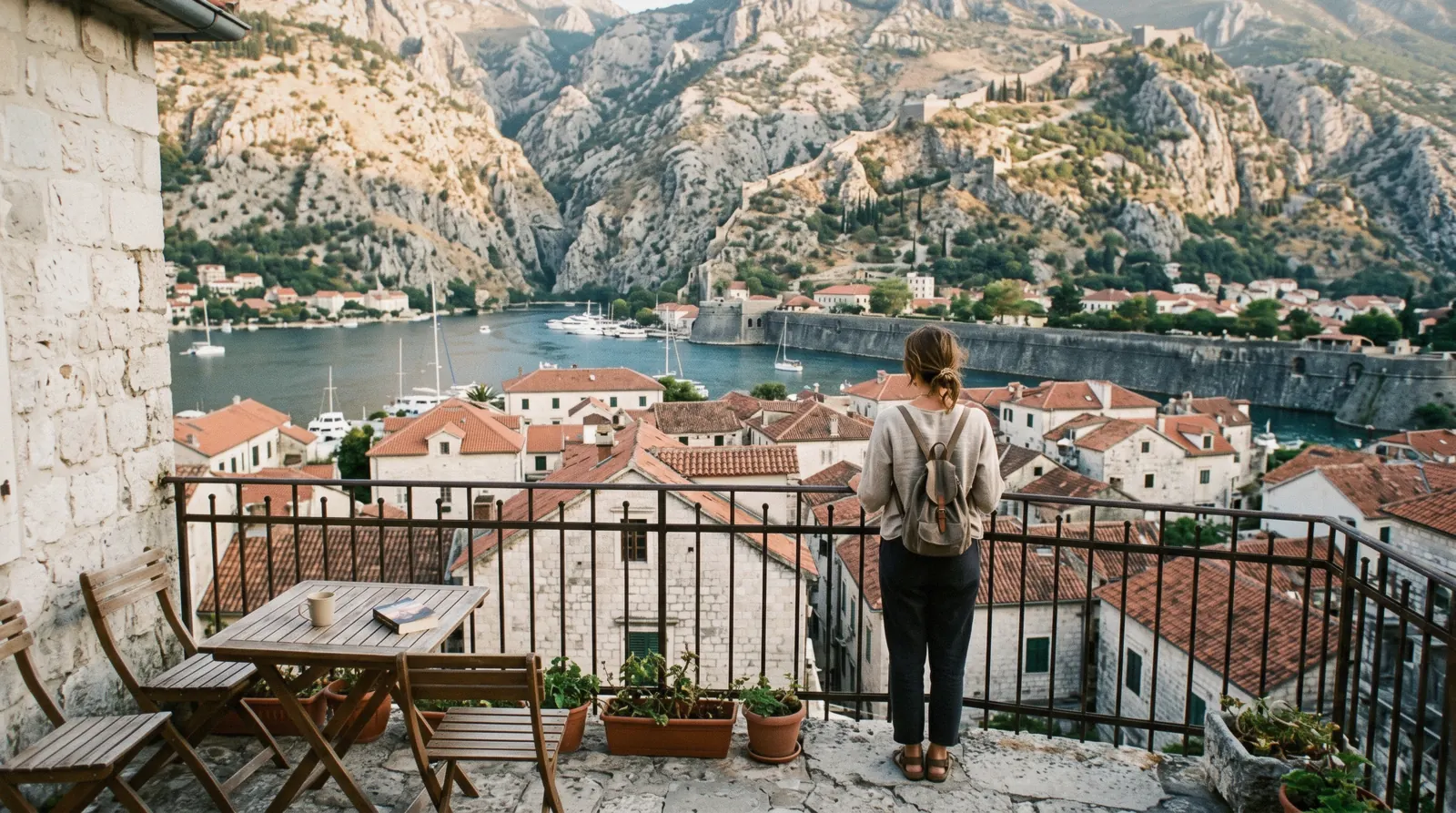
Where to Stay in Kotor: Walls, Waterfront or the Bay
Where to stay in Kotor is a choice between the walls, the water and the marina. Where to stay in kotor Kotor is a small town with an unusual shape, and where you sleep changes the trip more than in most cities. Everything crowds toward the head of the bay: the walled town under its fortress, the waterfront strip of Dobrota running north, the hillside suburbs of Škaljari above, and the string of quiet bay villages toward Perast. Across the water sits Tivat with its marina and its airport. Each of the five areas costs differently, walks differently and parks differently, and the differences are bigger than you would expect from a town this size. This guide compares them all, names the practical realities nobody puts on booking sites (the stairs inside the walls, the absence of any parking there, the €1 residence tax) and hands you off to the pages that list the actual rooms. For the full inventory, start with Kotor hotels, apartments and the hostel page. The full guide lives on Kotor City Guide.
Quick answer The answer first, then the details that decide it
First trip, no car, want atmosphere: sleep inside the walled town and accept the stairs. Want water at your doorstep with an easy walk to town: pick Dobrota. Have a car and care about easy parking and softer prices: pick Škaljari or the upper town. Want quiet, water and a holiday-house feel: Prčanj or Orahovac on the bay. Flying in late or travelling with kids who want the marina: Tivat. Every one of these choices is explained in full below, and each links through to the listings that carry actual rooms.
Key takeaways
- The next stop after this page: What Each Area Puts Within Reach.
- The full guide lives on Kotor City Guide.
- The full guide lives on Kotor City Guide.
The five sleeping areas, how far they put you from the old town walls, and who each suits best. Distances are descriptive (the sources describe Dobrota as a walk or short drive from the walls) because no official walking-time table exists for the town.
| Area | Walk to the walls | Best for |
|---|---|---|
| Inside the walled town (Stari Grad) | Zero. You wake up inside them | Atmosphere, short stays, car-free travellers |
| Dobrota waterfront | A walk or a short drive along the water | Swimmers, longer stays, couples |
| Škaljari and the upper town | Above town, downhill into the centre | Drivers, parking, value hunters |
| Prčanj and Orahovac on the bay | A drive or bus ride around the bay | Quiet, water access, a week-long base |
| Tivat | A drive around or over Vrmac | Airport arrivals, marina life, families |
No official nightly-rate bands exist for Kotor accommodation, so no price column appears here. We say so openly: any site printing one is guessing. Figures current in Q3 2026.
Stari Grad
-
Inside the Walled Town
old town rooms
The walled town is the reason most people come to Kotor, and sleeping inside it is the only way to own it. The walls themselves run about 4.5 km above the roofs, Venice ruled here from 1420 to 1797 and left the town's architecture, and UNESCO inscribed the whole ensemble in 1979. Only about 1,360 people actually live inside the walls (2023 census), which tells you how small and dense the place is. Step out of your door at seven in the morning and you have the Square of Arms, the leaning 1602 Clock Tower and St Luke's church of 1195 to yourself, hours before the first ship's excursion arrives through the Sea Gate. The old town is fully pedestrian, so there is nothing to drive, nothing to navigate and nothing to park. For the same reason there is no parking at all: cars stop at the lots outside the walls and you carry your bags in. The walls ticket is €15 ($17.12) in the main season at the gate, or the same admission sold online as the Kotor city walls entry ticket, so on a two-night stay the fortress climb starts at your own doorstep. English is widely spoken here, and the tourist info point sits by the Sea Gate and on Arms Square if anything needs sorting.
Tip: Best for first visits of one to three nights without a car. Expect stairs, stone and noise from late-night bars in season. Full room listings sit on the Kotor hotels and old town pages.
Dobrota
-
Dobrota Waterfront
waterfront stays
Dobrota is the string of old captains' houses and stone quays that runs north from the walls along the water. It counted 7,345 residents at the 2023 census, so it is a real neighbourhood rather than a resort strip, and it is the part of Kotor where you can actually swim: the town itself has no sandy beach, and swimming here is off stone slabs and quays in calm, deep, clear water. The sources describe it as a walk or short drive from the walls, which in practice means an evening stroll along the waterfront and a fifteen-minute return after dinner. Rooms here lean toward waterside apartments and small guesthouses with terraces over the bay, and the apartments page is the place to compare them. Staying in Dobrota also puts you close to the water-tour departure points: the boats for the Blue Cave speedboat tour and the four-hour Blue Cave and Perast cruise leave from the quays near Park Slobode, at the Dobrota end of town, so a morning on the water starts minutes from your door.
Tip: Best for swimmers, couples and anyone staying a week or more who wants water without living inside a museum. No lifeguards are mentioned by any official source for these swimming spots.
Škaljari
-
Škaljari and the Upper Town
upper town rooms
Škaljari is the residential quarter that climbs the hillside immediately above and behind the old town. The 2023 census counted 3,342 people here, roughly two and a half times the population of the walled town itself, and the housing stock shows it: family apartments, rooms over garages and modern builds with balconies facing the bay. This is the area the geography rewards with the two things the walled town cannot offer, parking and prices. The old town allows no cars at all, so if you arrive with a rental the lots outside the walls are your only option, and sleeping uphill means you often get a space at the property itself. It also puts you at the foot of two uphill attractions. The lower station of the Kotor cable car sits at Dub above Škaljari, and taxis charge about €20 ($22.82) each way from town if you are not walking it. The same hillside carries the Škurda canyon, the gorge that drops straight above the old town and is run commercially as the Škurda canyoning trip, four hours of abseiling and swimming inside a canyon most visitors never notice from the square below.
Tip: Best for drivers and anyone whose budget decides the trip. The walk down to the walls is short and downhill. The walk back is the price you pay.
Prčanj and Orahovac
-
Prčanj and Orahovac on the Bay
bay villages
Turn your back on the mountains behind Kotor and follow the shoreline toward the Verige Strait and you reach Prčanj and then Orahovac, two of the well-preserved bay towns the sources list alongside Kotor, Risan, Perast, Tivat and Herceg Novi. The bay itself is a drowned river valley about 28 km long with a shoreline of 107.3 km, and these villages sit on its quiet inner arm, where the water is calm enough for swimming off the quays and the cruise-ship rhythm of Kotor never arrives. Sleeping here means a holiday-house rhythm: terraces, gardens, water at the end of the lane. It also means a car, or a commitment to the local buses that leave from the bus station by the sea in Kotor. The trade is worth it for many travellers, because the bay's headline sights are close by water if not by road. Perast and its artificial island of Our Lady of the Rocks, built over centuries from rocks and scuttled ships loaded with stone, lie just up the shore, and the budget Perast and Our Lady of the Rocks boat tour and the full-day bay cruise with a swim stop both work from this side of the water.
Tip: Best for a week-long base and remote workers who have already seen the old town. If you drive, a rental is what opens this whole shore. see Kotor car rental.
Tivat
-
Tivat and the Marina Side
Tivat stays
Tivat sits across the hill from Kotor on the other inner bay, and choosing it is a different kind of trip: marina walks and airport logistics instead of walls and staircases. Its practical case is strong. Tivat Airport is about 5 km from Kotor as the crow flies and served by about 25 airlines in 2026, including easyJet, Jet2, Air Serbia, Turkish Airlines, Lufthansa, Air France and Norwegian, so a late flight lands minutes from a Tivat bed rather than a night drive around the bay. For the transfer question the cleanest answer is the private airport transfer van, priced per vehicle for up to eight people with a name sign in arrivals and the fare fixed before you fly. Tivat also changes your day-trip geometry. Two of the big circuits, the Great Montenegro tour and the Tara rafting day, offer departures that meet at the Porto Montenegro parking lot, so sleeping in Tivat can mean boarding the bus at the doorstep instead of crossing to Kotor first. The cost is distance from Kotor's walls, which means a drive around the bay or over the Vrmac tunnel every time you want the old town.
Tip: Best for late arrivals, families with a car, and travellers pairing the bay with Budva, which sits down the same coast road. See getting around Kotor for the road and bus picture.
Numbers match the list — tap a pin for the guide.
The Parking Reality
No Cars Inside the Walls, Ever
This is the single fact that most changes a Kotor accommodation choice, and booking sites bury it. The old town is fully pedestrian. Parking inside the walls does not exist, so every driver parks at the lots outside the walls and walks bags in.
If you are staying in the walled town, budget the walk twice: on arrival with luggage and on departure. If you are staying in Škaljari, Dobrota by car, or Tivat, ask the property directly about its own parking before you book, because the sources do not publish a per-property parking inventory for the town. A rental car is still worth having in this region, since it is what opens Njeguši, Cetinje and Lovćen in a single day over the old serpentine, and the car rental page covers the hire questions.
But treat the car as a bay-and-mountains tool, not an old-town one. If you would rather see the hairpin viewpoints without driving them at all, the hop-on hop-off bus with walking tour runs the serpentine route every 20 to 25 minutes on a one-day ticket.
The Stairs Reality of Walled-Town Rooms
Stone, Steps and Suitcases
Kotor is a vertical town. The fortress climb alone is about 1,350 stone steps rising roughly 280 m to San Giovanni, and the same geometry repeats inside the walls in miniature: buildings that lean together over lanes, upper floors reached by steep stone staircases, and no lifts in buildings that are centuries old. Nothing in our sources publishes per-property access details, which is itself worth knowing, so the practical move is to ask two questions before booking a walled-town room: which floor, and how many steps from the street.
Travellers with heavy bags, small children in pushchairs or limited mobility should weigh this honestly against Dobrota, where waterfront apartments tend to open straight onto the quay, or Škaljari, where modern builds sit by the road. For a structured visit that keeps the walking manageable, the one-day and two-day routes on Kotor in 1 day and Kotor in 2 days both start from the Sea Gate and stay on the level inside the walls.
The Residence Tax, Collected at Check-In
€1 Per Person Per Night, Paid to Your Host
Every overnight guest in this part of Montenegro pays the residence tax, the boravišna taksa, and the rule is simple: €1.00 ($1.14) per person per night, collected by your accommodation, with children under 12 exempt and ages 12 to 18 paying half. Two practical notes follow from the same source. Your accommodation registers you with the authorities, so hand over passport details at check-in without worrying, and if you are in a private stay that skips the paperwork, you register yourself at the tourist organisation within 24 hours.
A family of four staying five nights with two children over 12 should expect a small cash line on the bill at the end. Montenegro uses the euro unilaterally, meaning it is not a eurozone member but prices in euros anyway, so no currency conversion surprises await you at the desk. The wider cost picture, from food to the walls ticket to the cable car fares of €25 ($28.53) return for adults, lives on the Kotor costs page.
Which Area Suits Cruise Mornings
Timing Your Base Around the Ships
Kotor calls itself the third cruise destination in the Adriatic after Venice and Dubrovnik, and about 523 calls from roughly 85 ships are scheduled across 2026. The pier sits about 100 m from the old town walls and passengers walk two to five minutes to the Sea Gate, so on a big-call day the walled town fills with day visitors from mid-morning onward. That shapes where you should sleep.
Inside the walls, the cruise crowds pass through your living room, but the pattern is predictable and the mornings and evenings stay yours, which is exactly why atmosphere-first travellers still choose it. Dobrota sits outside the pedestrian flow entirely, a walk north along the water. Prčanj, Orahovac and Tivat sit beyond it altogether.
If your own visit is a cruise stop rather than a stay, the port page explains the walk and the four-hour shore excursion timed to the ship's call covers the bay's two headline stops between gangways. One more timing note: ships must pass the 340-metre-wide Verige Strait to reach the pier, so arrival times slip when traffic stacks up, and the bay villages notice the passing ships more than Kotor does.
What Nobody Publishes: The Price-Band Problem
Why This Page Prints No Room Prices
Here is a negative finding we consider content in itself. No published nightly-rate table exists for Kotor accommodation from any official source we checked. Seasonal swings, event weeks and the sheer size of the private-apartment market mean rates move constantly, and we will not invent a 'budget', 'mid-range' or 'luxury' band that no source supports.
Any page that prints one is guessing. What we can do is point you to the listings that show live prices, which is what the hotels, apartments and hostel pages are for, and fix the one number every guest pays regardless of room rate: the €1.00 ($1.14) per person per night residence tax. Treat the choice of area, not the choice of price band, as the real decision, because in a town this small the difference between sleeping inside the walls and sleeping in Prčanj shapes your days far more than a few euros a night does.
Near Your Base
What Each Area Puts Within Reach
Whichever area you pick, the same region spreads out around it, only the travel time changes. From the walled town, the fortress climb, St Tryphon's Cathedral of 1166 and the Maritime Museum are all on foot, and the free sights are gathered on the free things to do page. From Dobrota, the quays themselves are the attraction and kayaking the bay starts close by. From Škaljari, the cable car lower station at Dub and the best views of Kotor up the serpentine are your evening routine. From Prčanj and Orahovac, the bay opens up: Perast and Our Lady of the Rocks, with its island admission of €5 ($5.71) per guest in cash since the 2026 season, sit up the shore. From Tivat, the sandy beaches people actually mean when they search Kotor beaches, such as Plavi Horizonti on the Tivat side, are near, and Budva down the coast road makes an easy run. Day trips further out, from Lovćen National Park to Durmitor, are collected on the day trips hub, and the evenings have their own guide at Kotor at night.
The Sleeping Areas of the Bay
Where you sleep is a geography decision first. These are the five sleeping areas, described as ground rather than rankings; no official source publishes nightly-rate bands for Kotor, so this page prints none.
Inside the Walled Town
- Suits
- The walled town is the reason most people come to Kotor, and sleeping inside it is the only way to own it. The walls themselves run about 4.5 km above the roofs, Venice ruled here from 1420 to 1797 and left the town's architecture, and UNES
Best for first visits of one to three nights without a car. Expect stairs, stone and noise from late-night bars in season. Full room listings sit on the Kotor hotels and [old town](/
See stays in Inside the Walled TownDobrota Waterfront
- Suits
- Dobrota is the string of old captains' houses and stone quays that runs north from the walls along the water. It counted 7,345 residents at the 2023 census, so it is a real neighbourhood rather than a resort strip, and it is the part of Kot
Best for swimmers, couples and anyone staying a week or more who wants water without living inside a museum. No lifeguards are mentioned by any official source for these swimming spots.
See stays in Dobrota WaterfrontŠkaljari and the Upper Town
- Suits
- Škaljari is the residential quarter that climbs the hillside immediately above and behind the old town. The 2023 census counted 3,342 people here, roughly two and a half times the population of the walled town itself, and the housing stock
Best for drivers and anyone whose budget decides the trip. The walk down to the walls is short and downhill. The walk back is the price you pay.
See stays in Škaljari and the Upper TownPrčanj and Orahovac on the Bay
- Suits
- Turn your back on the mountains behind Kotor and follow the shoreline toward the Verige Strait and you reach Prčanj and then Orahovac, two of the well-preserved bay towns the sources list alongside Kotor, Risan, Perast, Tivat and Herceg Nov
Best for a week-long base and remote workers who have already seen the old town. If you drive, a rental is what opens this whole shore. see Kotor car rental.
See stays in Prčanj and Orahovac on the BayTivat and the Marina Side
- Suits
- Tivat sits across the hill from Kotor on the other inner bay, and choosing it is a different kind of trip: marina walks and airport logistics instead of walls and staircases. Its practical case is strong. Tivat Airport is about 5 km from Ko
Best for late arrivals, families with a car, and travellers pairing the bay with Budva, which sits down the same coast road. See getting around Kotor for the road and bus pic
See stays in Tivat and the Marina SideWe take a commission if you book through these links, at no extra cost to you.
Where should I stay in Kotor for the first time?
Inside the walled town, if you are not driving. You step out of the door into the UNESCO-listed lanes, the fortress path and the Sea Gate are minutes away, and English is widely spoken there. The trade is stairs and no parking, so if you arrive by car or want easier access, choose Dobrota for water and a walk, or Škaljari for parking. Both are a short move from the walls.
Can you stay inside Kotor old town?
Yes. Around 1,360 people live inside the walls, and guesthouses and small hotels operate among them. The realities are a fully pedestrian district, steep stone stairs to most upper floors and no parking at all inside the walls, so cars use the lots outside. Ask any walled-town property which floor the room is on and how many steps lead to it before you book.
Where do you park when staying in Kotor?
Outside the walls, always. The old town is fully pedestrian and parking inside it does not exist, so drivers use the lots outside the walls and walk in. If parking decides your trip, Škaljari and the upper town are the residential areas where properties more often have their own space, and Tivat works too. Confirm parking with the specific property, because no published per-property parking list exists.
Is Dobrota too far to walk to Kotor?
No. The sources describe Dobrota as a walk or a short drive from the walls, and it runs along the waterfront directly north of the old town, so an evening walk in for dinner is a normal part of staying there. You gain swimming off the stone quays, waterside apartments and distance from the cruise crowds. It is the middle choice between living inside the walls and sleeping out on the bay.
Should I stay in Kotor or Tivat?
Stay in Kotor for the walled town, the fortress and the atmosphere, and in Tivat for the airport, the marina and a calmer base. Tivat Airport is about 5 km from Kotor and served by about 25 airlines in 2026, so late arrivals often sleep better in Tivat. Kotor keeps you inside the sightseeing. If you have a car you can split the difference, since the drive between them runs around the bay or through the Vrmac tunnel.
What taxes or extra fees will I pay at my Kotor accommodation?
The residence tax: €1.00 ($1.14) per person per night, collected by your accommodation, with children under 12 exempt and 12 to 18 paying half. Your property registers you with the authorities at check-in. Beyond that, no other compulsory accommodation fees appear in any source we checked. Montenegro prices in euros even though it is not a eurozone member.
We may earn a commission if you book through one of our links, at no extra cost to you. Full affiliate disclosure