 Kotor City Guide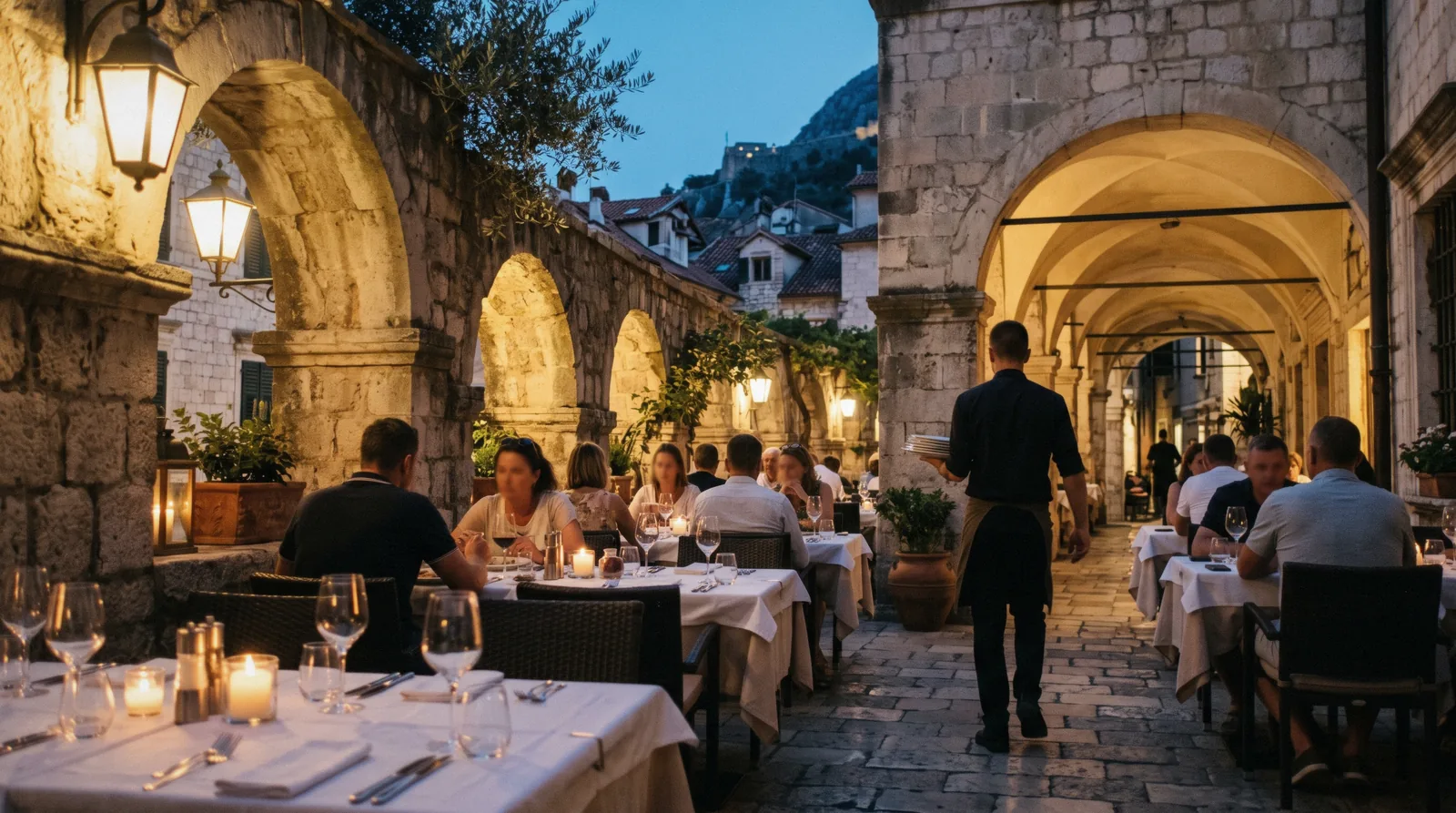
The Best Tables in Kotor: How to Choose Without a Ranking
Kotor has no Michelin guide, no Slow Food list and no restaurant ranking that a traveller can check. The negative finding matters: the inspectors have no Montenegro coverage at all, so any article claiming to name the best restaurants in Kotor is working from taste, payment or nothing. This page does the honest thing instead. It gives you a method. You will choose your table by setting, by what the kitchen actually cooks here, by the difference between a konoba and a restaurant, and by when you must reserve. Pair it with our where to eat guide for the practical listings, and with the Kotor food tour if you would rather have a local lead you through the bay's kitchen in one evening. The full guide lives on Kotor City Guide.
Quick answer The answer first, then the details that decide it
There is no ranking to trust, so build your choice from four questions. First, do you want water under your feet or stone walls around you. Second, do you want a tavern or a proper restaurant. Third, is the fish from the bay or from a freezer truck, which you judge by whether the catch is displayed and weighed at the door. Fourth, is a cruise ship docked, because if it is, you reserve or you eat early or late. The bay's kitchen is small and consistent: cured ham and cheese from the mountain village of Njeguši, black risotto, grilled fish from the bay, kacamak and honey brandy. Order those and you will eat well almost anywhere that takes its kitchen seriously.
Key takeaways
- The full guide lives on Kotor City Guide.
- The whole site's structure lives on Kotor City Guide; the practical layer is on the plan hub.
- The full guide lives on Kotor City Guide.
Why No Ranking Can Help You Here
The honest starting point
No citable restaurant ranking covers Kotor. Michelin has no Montenegro coverage, and the other bodies that publish lists elsewhere on the Adriatic do not publish here either. That is not a small gap, it is the whole picture: nobody independent has scored a single dining room in this town.
What exists instead is a market of listicles, many of them paid placements wearing the clothes of journalism. When every page claims a number one and no authority stands behind any of them, the ranking format stops carrying information. Treat every list, including lists you find on travel forums, as an opinion with unknown provenance.
What you can verify instead
Two things are checkable and they take you further than any list. The first is the venue itself: a serious kitchen in Kotor tells you where its fish came from, displays the day's catch, and cooks the bay's own dishes rather than a generic tourist menu printed in six languages. The second is your own calibration: a single good food walk with someone who lives here resets your sense of what local food should taste like.
The Kotor food tour with a local guide does exactly that over three hours of pršut, cheese, wine and honey brandy. After it, you can read any menu in town and know within a course whether the kitchen cares.
Choose by Setting: Waterfront Table or Stone Courtyard
On the water
The bay is a drowned river valley about 28 km long, ringed by mountains, and the town's quays sit right on it. A waterside table buys you the view across to the walls and the mountain wall behind, the slow traffic of small boats, and in the evening the lit silhouette of the fortress above town. The trade is real: the water-facing terraces are the first place day visitors from the cruise pier land, since the terminal gate is a few minutes' walk from the Sea Gate.
If you want the view, aim for the edges of the dinner window, early or late, or book.
Inside the walls
The old town has been on the UNESCO World Heritage list since 1979, and its Venetian-era streets hold the courtyards. A table in a stone lane or under a palace arch trades the panorama for shade, quiet and a sense of eating inside the town's actual fabric. Streets a single turn off the main squares run noticeably calmer.
The old town guide maps the lanes, and our map of Kotor shows how short every walk is: nothing inside the walls is more than a few minutes from anything else, so choosing by kitchen rather than by address costs you almost no effort.
Out along the bay
The shoreline villages north of town, such as Dobrota and Prčanj, put restaurants on the water without the cruise-day pressure. Dobrota counts more residents than the walled town itself and runs along the bay in a single line, which is why several of its waterfronts keep a local evening crowd. Reaching them is an easy taxi or a walk along the water for Dobrota.
Our getting around Kotor page covers the options. If your table matters more than your after-dinner stroll, this is the direction to look.
Konoba, Tavern or Restaurant: Know the Words Before You Choose
What a konoba is
A konoba is the Dalmatian and Bokelian word for a tavern, historically the plain room where fishermen and their families ate. On the bay it signals a specific promise: simple cooking, grilled and smoked things, wine from the region, and an interior of rough stone and old tools rather than a designed dining room. It is not a grade, it is a genre.
Some konobas are family operations of real quality, others trade on the word alone. The reliable tells are a short menu, a catch on display, and staff who can tell you which village the ham came from.
What a restaurant promises instead
A full restaurant, as opposed to a tavern, runs a longer menu, takes reservations systematically and can handle the whole range from seafood platters to plated desserts. This is where the finer end of eating in Kotor sits, and it is where our second owned idea, Kotor fine dining, lives: not a starred scene, because none exists here, but a handful of kitchens working to a higher standard of plating and service than the taverns. Expect smaller rooms and a bill that reflects the extra labour.
English is widely spoken throughout the old town, so asking what arrived fresh that day works everywhere.
The Cruise-Season Reservation Rule
Why the ships decide your evening
The Port of Kotor calls itself the third cruise destination in the Adriatic after Venice and Dubrovnik, and the scale backs the claim: about 523 calls from roughly 85 ships are scheduled for the year, with around 41 calls landing in the busiest shoulder month. Ships dock rather than tender, and passengers walk 2 to 5 minutes to the Sea Gate. A single large call can add thousands of people to a walled town of roughly 1,360 residents.
The small dining rooms simply cannot absorb that number at 19:00.
The rule and its exceptions
The rule: if a ship is in port, reserve. Book the afternoon before for that evening, or book in the morning on your way past. The exceptions: eat before 18:30 or after 21:00, when the day-tripper flow has drained back to the pier, or walk north along the quay toward Dobrota where the pressure drops with every hundred metres.
Our Kotor in 2 days and Kotor in 3 days itineraries build dinner around exactly this pattern. Note also that ships must pass the 340-metre-wide Verige Strait to reach the pier, so arrival times slip when traffic stacks up, and a ship listed for morning can still be unloading its first wave at your dinner hour.
How the day shapes your appetite
Plan the meal around the day's effort. A morning climb of the city walls earns a long lunch, since the walk up runs about 1,350 steps to the fortress. A day on the water calls for grilled fish and little else.
And a day trip over the mountain to Njeguši, where the bay's smoked ham and cheese are made, sets up the ideal Kotor dinner: order the same pršut in town that evening and you will taste what the mountain air does.
What to Order: The Bay's Own Dishes
The short list
The bay's taverns cook a compact repertoire and they cook it well. Njeguški pršut is ham dry-cured and wood-smoked in the village's mountain air, served with Njeguši cheese and bread. Crni rižot is the black risotto, the Dalmatian cousin cuttlefish dish that turns the plate inky and tastes of the sea.
Grilled fish from the bay is sold by weight, whole, and is the single best test of a kitchen. Kacamak is the mountain comfort dish, a cornmeal and cheese porridge that fisherman folklore pairs with cold weather and hard mornings. Medovača, honey brandy, closes the meal.
Matching dish to venue type
The table below is a decision tool, not a ranking. Read your appetite across to the kind of place that cooks it best, then use our where to eat guide to put names on the map.
Dish to Venue Type
| Dish | Where it is cooked best | Why |
|---|---|---|
| Njeguški pršut and Njeguši cheese | Konoba or family tavern | The ham is aged in mountain air in Njeguši, so taverns with family ties to the villages slice it properly rather than buying pre-packed |
| Crni rižot (black risotto) | Konoba with a seafood focus | A fisherman's dish built on cuttlefish ink, so the taverns closest to the catch do it justice |
| Grilled fish from the bay | Waterfront restaurant or tavern with the catch displayed | Sold whole by weight, so you want a place that shows and weighs the fish at the door |
| Kacamak | Inland-style tavern, mountain-influenced kitchens | A cornmeal and cheese dish of the highlands, not a seafood plate, so order it where the menu leans mountain |
| Medovača (honey brandy) | Any of the above, or the food tour | A closing drink rather than a course, and the food tour pairs it with the ham and cheese it comes from |
Price Tiers Without Invented Numbers
No euro figures are printed because no source publishes a Kotor dining price list. Figures for entry tickets elsewhere on this site are current as noted on their own pages.
Why we print tiers and not euro figures
No source publishes a Kotor dining price table, and we will not invent one. What we can tell you is how the tiers differ, so you can read any menu on the door and place it in seconds. A note on currency first: Montenegro uses the euro unilaterally and is not a eurozone member, so every menu is in euro.
For reference, the walls ticket runs €15 ($17.12) and the Maritime Museum €4 ($4.56), which gives you the scale of a small-ticket euro here.
The Tier Decision Table
| Tier | How the menu reads | Choose it when |
|---|---|---|
| Plain tavern | Short menu, dishes named without adjectives, catch priced per kilogram | You want the bay's food exactly as families eat it and care more about the kitchen than the room |
| Mid restaurant | Longer menu, mixed seafood and meat, daily specials board, reservations taken | You want one dependable sit-down dinner without ceremony, the default choice for most visitors |
| Fine dining room | Tasting format or composed plates, wine list with regional bottles, service that paces courses | You want the evening itself to be the event, and you will book ahead in cruise season |
| View terrace | Premium sits on the position, not the cooking, so the menu overlaps the mid tier | The water view is the point of the meal and you are eating early or late to hold the table |
The Family-Run Reality
Small rooms, real owners
The dining economy here is built on family operations. The old town holds only about 1,360 residents, the rooms are small, and the person taking your order is often the owner or the owner's relative. That shape has consequences worth planning around.
Hours can be personal: a place closes when the family needs it to, and a kitchen that served until late in July may keep shorter hours once the season thins. Service runs at house pace, not restaurant-Chain pace. Cash is worth carrying alongside card for the smaller taverns.
None of this is a flaw, it is the texture that makes eating here different from eating in a resort town, but it rewards travellers who book, arrive roughly on time, and treat the room as someone's home.
What nobody publishes, and why it matters
Beyond the missing ranking, two silences are telling. No official body publishes sanitation or kitchen-standard scores for Kotor venues, so there is no star or letter system to lean on the way there might be elsewhere. And no venue-by-venue seasonal calendar exists, so which taverns stay open through the quiet months is knowledge that lives in the town, not on the internet.
The practical reading: judge each place in front of you, on the catch, the menu and the room, rather than hunting for a score that was never written.
Build the Evening Around the Table
Eat after the day, not instead of it
Kotor rewards the long dinner because the days are full. A morning on the water with the Blue Cave speedboat tour, which loops past Our Lady of the Rocks and the submarine tunnel before the swim at the cave, sets up a grilled-fish evening perfectly. A day over the mountains, which our day trips page covers, ends best with kacamak and a carafe of local red.
And if the whole day was about the walls and the old town, our things to do and free things to do pages both route you past squares where an aperitif before dinner is half the pleasure. Finish with a walk: the evening in Kotor page describes how the lit walls change the town after the day boats leave.
Let one evening be taught
If you take a single guided eating experience, make it the Kotor food tour with a local guide, a private three-hour walk run by the operator that guidebook writer Rick Steves sends people to. It reads as a tasting menu of the bay's kitchen, from cured ham through cheese and wine to honey brandy, and it meets in front of the Sea Gate, which puts you exactly where the evening's own table should follow. It is the most expensive three hours on this site and the only one that feeds you dinner.
Our food tour page carries the full card and booking details.
Tours That Feed You
One card belongs on this page, because it is the one tour on this site whose entire product is dinner. The platform bills in your own currency and prices are listed in US dollars as published.
Nearby Pages That Finish the Plan
Our where to eat hub holds the practical listings this method page deliberately avoids naming. The Kotor costs page puts the meal in the frame of the whole trip budget. For the mornings that earn the dinner, start at things to do or the bay of Kotor guide, and if you are deciding where to sleep near the good tables, the where to stay page breaks the town and the shoreline villages into honest areas.
Questions About Eating Well in Kotor
Do I need reservations in Kotor restaurants?
Yes, whenever a cruise ship is docked, which is often. About 523 calls are scheduled across the year and the pier sits roughly 100 m from the old town walls, so ship walkers fill the small dining rooms at peak dinner hours. Reserve for the evening, or eat before 18:30 or after 21:00. On days with no ship in port, walk-ins are usually fine. Our cruise port page explains the call pattern.
What should I eat in Kotor?
The bay's own dishes: Njeguški pršut and Njeguši cheese, the black risotto called crni rižot, grilled fish from the bay sold whole by weight, kacamak from the mountain tradition, and honey brandy to finish. Any kitchen that cooks these carefully is a safe table. The Kotor food tour walks you through the whole repertoire in one sitting.
Are Kotor restaurants expensive?
Not stated in any source we trust, because no official price table exists for Kotor dining and we will not invent figures. Structurally, the bill follows the tier: plain taverns sit below mid-range restaurants, view terraces charge for position, and the fine end charges for pace and service. Montenegro uses the euro unilaterally, so menus are in euro. Our Kotor costs page covers the trip budget around the meals.
What is a konoba?
A konoba is the local word for a tavern, historically the plain room where fishing families ate. It names a genre, not a quality grade: simple stone interiors, grilled and smoked food, regional wine. Judge one by its short menu, its displayed catch and whether staff can tell you where the ham came from.
Where do locals eat in Kotor?
No source publishes that map, and we will not pretend to one. What the geography does show is where the tourist pressure is not: the lanes one turn off the main squares, and the shoreline toward Dobrota, where more residents live than inside the walled town itself. A local guide can shortcut this, which is part of what the food tour is for, and our where to eat page lists the rooms with local followings.
We may earn a commission if you book through one of our links, at no extra cost to you. Full affiliate disclosure