 Kotor City Guide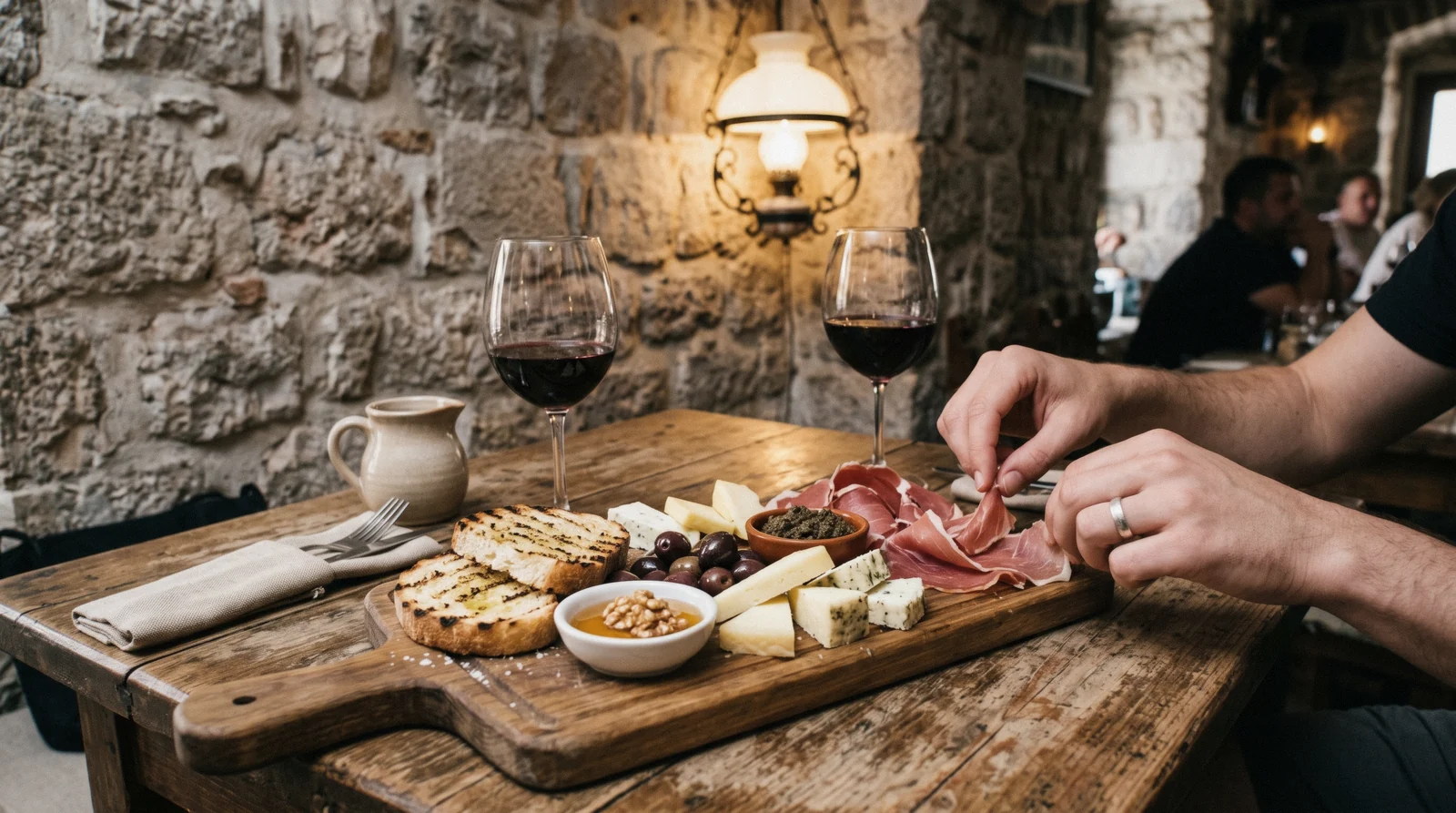
A Kotor Food Tour: What Three Hours and a Local Guide Buy You
Kotor is easy to eat in and easy to eat badly in. The walled town is small, the menus repeat, and the dishes that make this bay worth sitting down for are the ones that never make the photo boards: ham cured in mountain air, sheep cheese from a village over the serpentine, risotto turned black with cuttlefish ink, a corn-and-potato stew that fed herders, and a brandy laced with honey. A food tour is one answer to that problem. This page covers the one that exists here, the Kotor food tour with a local guide run by Miro & Sons Montenegro Tours, and it answers the question you are actually asking: is three hours and this much money better spent with a guide than on your own tab at a taverna? We have pulled every published fact about the tour, set it against the self-guided alternative, and explained each dish of the bay so the menu stops being a wall of unknown nouns. If you decide the tour is not for you, the route still matters, because the same plates are on taverna tables all over town and in our where to eat guide. The full guide lives on Kotor City Guide.
Quick answer The answer first, then the details that decide it
The Kotor food tour is a three-hour private walk run by Miro & Sons Montenegro Tours, the operator Rick Steves recommends in his coverage of Montenegro. It lists at US$163.05 per person, carries a 4.9 rating from 59 reviews, and reads as a tasting menu of the bay's kitchen: pršut, cheese, wine and honey brandy, with stops at tavernas and family shops inside the old town. You meet in front of the Sea Gate, the old town's main entrance, where the guide holds a name sign. It is the most expensive three hours on this site and the only tour here that feeds you dinner. Who should book it: travellers who want the context as much as the food, couples or small groups who like the private format, and anyone short on time who wants the bay's dishes explained in one evening. Who should skip it: budget travellers, who should read our self-guided grazing plan below and eat the same dishes from the best restaurants in Kotor list for less.
Key takeaways
- The full guide lives on Kotor City Guide.
- Where to eat: the page that owns this question is at Where to eat.
- Best restaurants kotor: the page that owns this question is at Best restaurants kotor.
What the Kotor Food Tour Covers
The route, as the operator and the listing describe it, is a walking tasting menu through the bay's kitchen. Four things are named outright: pršut, cheese, wine and honey brandy. That is the spine of the Boka table, and the tour strings it across stops at tavernas and family shops inside the walled town. The listing also mentions pasticada, the slow-cooked beef dish of the Dalmatian coast, so expect at least one cooked plate alongside the cured and fermented things. What three hours buys you is not really the food. You could order every one of these dishes yourself for less money, and we will show you how below. What you cannot buy by yourself is the guide standing next to you explaining why the ham tastes of smoke and mountain, which village the cheese comes from, why the wine tastes the way it does this far south, and what order to drink the brandy in. That is the product. The 4.9 rating across 59 reviews suggests the operator delivers it consistently, though the review count is small enough that you are trusting a small operation rather than a machine. The format is private group only. There is no shared departure where strangers join you, which raises the per-person price and removes the awkwardness. The walk is on foot through the old town, which is fully pedestrian, so there is no transport, no bus, no van. You eat, you walk a few hundred metres between stops, you eat again.
The Tasting Spine
Four named tastings carry the tour, and each one has a story worth knowing before you arrive. The table below sets out what each element is and where it comes from, so the first plate does not arrive as a surprise.
| Tasting | What it is | Where it comes from |
|---|---|---|
| Pršut | Dry-cured, wood-smoked ham, served thinly sliced with bread | The Njeguši tradition, aged in mountain air above the bay |
| Cheese | Njeguši cheese, the firm sheep and cow milk cheese of the village over the hill | Njeguši, on the Lovćen side of the serpentine |
| Wine | Local Montenegrin wine poured as a pairing | Not stated by source for the exact producer |
| Honey brandy | Medovača, a grape or plum brandy infused with honey | A bay-wide home and tavern tradition |
Who Runs It: Miro & Sons
The operator is Miro & Sons.
The operator is Miro & Sons Montenegro Tours, and the reason that name matters is a single line on the listing: this is the food tour Rick Steves recommends. In a town where tour operators multiply every summer and dissolve every autumn, an endorsement that survives a guidebook editor's fact-checking is worth something. It is also why this tour appears on Viator under a title that says so.
The numbers behind the operation are small and that shapes the experience. A 4.9 rating from 59 reviews on Viator and Tripadvisor means years of private departures, not a conveyor belt. A private-group-only format means the guide is yours. The listing states the guide speaks English and holds a name sign at the meeting point, in front of the Sea Gate. That gate, built in 1555 in the Venetian era, is the old town's main western entrance and sits a two to five minute walk from the cruise pier, so if you are in port for the day this is one of the few tours that fits a shore timetable and feeds you a meal at the same time.
One caution on scale: because this is a small operator running private tours, departure slots are limited, and the operator does not publish a timetable in the listing. Book early for the dates you want, and note the cancellation deadline of 24 hours before the start time, which is generous by the standards of small local guides.
If you want to compare this against the town's other guided formats, our Kotor tours page runs the full list, and the shorter old town walking tours cover the same streets with history instead of food.
The Price and What It Buys
Price Comparison The options compared here are exactly the ones this page's cards and the gate prices cover. The euro figure is the official one; the dollar gloss converts at €1 = $1.14.
| Product | Price | Duration | What you get |
|---|---|---|---|
| Kotor food tour with a local guide (private) | US$163.05 | 3 hours | Pršut, cheese, wine, honey brandy, pasticada, a guide, dinner |
| Blue Cave speedboat circuit | US$63 | 3 hours | Bay cruise, cave swim, three stops |
| Old town guided walking tour | US$25 to US$29 | 70 to 90 minutes | History, squares and churches, no food |
| City walls ticket | €15 ($17.12) | Self-guided | The fortress climb above the town |
| Full-day bay cruise | US$29 | 8 hours | The whole bay by covered ship with a swim stop |
Figures trace to the gate prices and cards on this site. Figures current in Q3 2026.
The Dishes of the Bay, Explained
Half the value of a food tour is that someone translates the menu before the food arrives. Here is that translation in advance, free. These are the dishes the bay's taverns cook, the ones the tour builds its route around and the ones you will meet again on every taverna menu in town.
Njeguški Pršut
This is the ham that opens the tour and, honestly, the reason most people book it. Njeguški pršut is dry-cured ham from the village of Njeguši, perched on the Lovćen side of the mountain above Kotor. The loin or leg is salted, cold-smoked over beechwood, then left to age in the village's mountain air, which is dry and moved by wind channelling between the bay and the interior.
The result is darker and smokier than Italian prosciutto, sliced paper thin and served with Njeguši cheese and bread. Family taverns on the main road through Njeguši run tastings of their own, which matters if you plan to drive the serpentine later. The practical line for the tour: it is the first tasting, it is abundant, and if you like it, our Njeguši page explains how to visit the village it comes from.
Njeguši Cheese
The cheese arrives alongside the ham because it always has. Njeguši cheese is a firm cheese made in the same mountain village from sheep and cow milk, pressed and aged until it turns dense and slightly sharp. It is a working food, built to survive a herder's day on the mountain, which is why it cuts into slices rather than spreading.
Eaten with the pršut and a slice of bread it is the plainest thing on the tour table and, for many travellers, the one they go hunting for afterwards in the town's small food shops. It travels reasonably well wrapped, so it is a legitimate thing to buy on the last day, and our Kotor shopping page covers where the food shops sit.
Crni Rižot, the Black Risotto
The black risotto is the bay's signature cooked plate, the Dalmatian cousin of the Italian risotto al nero di seppia. Cuttlefish or squid is cooked slowly in its own ink until the rice turns deep black and tastes of the sea in a way that sounds strange until you try it. The texture matters more than the colour: the rice should be creamy, the seafood tender, and the finish faintly sweet from the ink.
Every taverna on the water claims a version, and quality varies more with this dish than with any other on the bay, which is exactly when a guide's opinion earns its money. On the tour, expect it or a dish in its register among the cooked stops. If you end up ordering it alone, our best restaurants in Kotor page is where we would start.
Grilled Fish from the Bay
The bay has supported fishing families for as long as it has had towns, and the simplest expression of that is whole fish grilled over coals, dressed with olive oil, garlic and parsley, and served with chard and potato, the plate the Dalmatian coast calls green and potatoes. The fish market logic applies: what is on the menu depends on what came out of the water, so the species changes and the honest taverns say so. This is the dish the tour uses to show you what a good grilled fish tastes like before you spend a holiday ordering bad ones.
Watch how it is filleted at the table. That is a skill you can carry to every coastal town from here to Dubrovnik.
Kacamak
Kacamak is the mountain's answer to polenta, and it is the humblest dish you will taste all evening. Cornmeal is cooked slowly with potato and cheese until it turns into a soft, stretchy mass, traditionally pulled and folded with a wooden spoon until the cheese melts into strings through the whole pot. It was herder food, the calorie engine of a household with little else, and it survives on taverna menus as the dish locals order when they want to feel at home.
It is filling, cheap and easy to underestimate. If it appears on your tour, eat it warm and quickly, because the cheese strings set as it cools.
Medovača, the Honey Brandy
The tour closes on the drink that opens every Montenegrin home: medovača, a brandy infused with honey. The base spirit in this part of the coast is usually grape or plum rakija, and the honey rounds the fire of the alcohol into something golden, sweet and deceptively easy. It is served in small glasses, sipped rather than shot, and it is the traditional welcome drink and the traditional digestif at once.
Families make their own and argue about whose is better, which is the whole point of tasting it with a local rather than alone at a bar. Buy a bottle only if you liked the version you were given, because quality varies wildly and our Kotor at night page lists better uses for the evening than comparing brandies solo.
The Route: Where You Walk
The tour is a walk, and the walk is short. The old town inside the walls is compact, roughly a ten minute crossing at any diagonal, so three hours is almost entirely time at tables rather than time on pavement. The meeting point fixes the geography: in front of the Sea Gate, the old town's main western entrance, built in 1555, opening directly onto the Square of Arms. If you are arriving from the cruise pier, the gate is a two to five minute walk along the sea wall. The guide holds a name sign. The operator does not publish the stop-by-stop list of venues, and that is worth saying plainly: no source we checked names the individual tavernas and family shops on the route. That is normal for food tours, which protect their supplier relationships, but it means you are booking the operator's judgement rather than a venue list. The named content is the food itself, the four tastings plus the cooked dishes, delivered across multiple stops. Two practical notes on the ground you will cover. First, the old town is fully pedestrian, so wear whatever you would wear for an evening stroll, and note that some lanes are stone and smooth with age. Second, the town's landmarks will keep appearing between stops: the Clock Tower of 1602 leaning slightly toward the gate, St Luke's church of 1195, St Tryphon's Cathedral with its unequal towers. Our old town page covers all of them if you want the history separately, and the Kotor map page pins every one.
Landmarks You Pass
The food is the tour, but the streets between stops are part of what you pay for. These are the landmarks inside the walking radius, all covered in detail on their own pages.
| Landmark | Why it matters | Distance from the meeting point |
|---|---|---|
| Sea Gate | The 1555 Venetian water gate and the tour's meeting point, opening onto the Square of Arms | You start here |
| Square of Arms and Clock Tower | The main square, with the 1602 Clock Tower leaning toward the gate and a medieval pillory in front of it | Immediately inside the gate |
| St Tryphon's Cathedral | Consecrated in 1166, damaged in the 1667 earthquake, towers famously unequal after rebuilds | A few minutes' walk into the town |
| St Luke's Church | Built 1195, served Catholic and Orthodox congregations together, said to be the only building that survived the great earthquakes intact | A few minutes' walk into the town |
The Self-Guided Alternative
The honest case against the tour.
The honest case against the tour is simple: every dish on the route is on a taverna menu in town, and you can assemble the same evening yourself for meaningfully less money. The listing for the tour says as much in its own alternative line, pointing DIY grazers at a taverna guide. Here is how we would run it.
Pick three venues from our where to eat guide, spaced across the old town so the evening becomes a walk with plates at each end. At the first, order the pršut and cheese plate, which most tavernas carry, and a glass of local wine. At the second, order the cooked dish: crni rižot if you want the bay's signature, grilled fish if the catch looks good, kacamak if you want the mountain on a plate. At the third, finish with medovača and coffee. Read our best restaurants in Kotor page for the shortlist.
What you lose is real, though, and it is worth naming. One: no citable restaurant ranking covers Kotor, no Michelin, no Slow Food, no Gambero Rosso, so venues are named only by their own sites or published lists, and your own research carries more risk than a guide's nightly experience. Two: nobody explains anything. The story of Njeguši, the reason the ham tastes of smoke, the correct way to drink the brandy, all of that arrives only if you ask a waiter mid-service or read it here first. Three: the tour is private and continuous, so the evening needs no decisions. The self-guided version is an evening of small choices, which some travellers love and some are too tired for.
A middle path exists for mountain-curious eaters: drive or tour the serpentine to Njeguši itself and taste the ham where it is aged, in family taverns on the main road that run tastings. The Lovćen cable car, Njeguši and Cetinje day tour includes a Njeguši ham and cheese stop, or you can read our Njeguši page and go alone.
When to Book and When to Go
The tour runs as a private.
The tour runs as a private departure, so timing is largely yours to negotiate with the operator within their availability, and the listing does not publish fixed departure times. Three considerations should shape what you ask for.
First, season. Kotor's weather runs from average highs of 29.7C in August to 10.9C in January, and the town's rhythm follows: summer evenings are busy and warm, winter is quiet and the rain peaks in November at 354 mm on recent climate normals. An evening food tour works best in the warm months, when the tavernas spill onto squares and the walk between stops is a pleasure rather than a between-showers dash. Our best time to visit Kotor page runs the full seasonal trade-off.
Second, cruise traffic. About 523 cruise calls are scheduled for 2026, and on call days the old town's squares thicken from mid-morning. An evening slot puts your tour after most day-trippers have sailed, which is when the town belongs to the people sleeping in it. If you are the cruise passenger, the Sea Gate meeting point is a two to five minute walk from the pier and the three hours fit comfortably inside a port call, but confirm your ship's all-aboard time against the start time before booking. Our cruise port page covers the timings.
Third, lead time. A small operator running private tours has finite evening slots, and summer Saturdays go first. Book as soon as your dates are fixed, and rest easy about the commitment: cancellation is free up to 24 hours before the start, which is the same window as nearly every tour in town. Our plan hub collects the booking-order questions for the rest of the trip.
Practicalities: Money, Language and Kids
Money first. Montenegro uses the euro.
Money first. Montenegro uses the euro unilaterally, without being a eurozone member, so cash in your pocket should be euros and the tour price on the platform bills in your own currency at checkout. The tour price includes the tastings as listed, and the listing does not state any extras, so there is nothing to hand over in cash on the night as far as the published information goes. Tipping norms are not stated in any source we checked, so we print nothing on it. Our Kotor costs page handles the wider budget, including the €1.00 per person per night residence tax your accommodation collects.
Language is a non-issue. English is widely spoken in Kotor's old town, and the tour is guided in English. The town's tourist information point sits by the Sea Gate and on Arms Square, so if anything about your booking needs sorting in person on the day, help is at the meeting point itself.
Kids: the listing states no minimum age and no child price, and the private format is actually the friendliest version of a food tour for families, because the pace, the stops and the menu adapt to your table rather than a coach of forty. Fussy eaters do better on a private tour than anywhere else in the food-tour world. Our Kotor with kids page covers the wider town, including the cat squares that will hold a child's attention longer than any cathedral. Accessibility is not stated in the listing, so travellers with mobility needs should message the operator directly before booking, since the old town's lanes are stone and some venues may have steps.
How It Fits Your Kotor Days
Three hours of eating fits best.
Three hours of eating fits best as an evening, and the tour pairs naturally with a day spent on the water or the walls rather than another walking product. Our preferred shape: climb the fortress in the cool of the morning, since the walls climb is about 1,350 steps and 45 to 60 minutes up, spend the afternoon on the bay or the beach question of your choosing, then let the food tour be dinner.
If your trip is short, the tour slots cleanly into a two-night stay as the anchor evening, with a self-guided day from our Kotor in 2 days itinerary built around it. Longer stays can pair the tour with the mountain: the Njeguši connection means you can taste the ham on the tour one evening and stand in the village it comes from the next day, either on the day trip to the cable car, Njeguši and Cetinje or under your own steam with our Njeguši and Lovćen National Park pages.
Rain changes the calculus in your favour. The tour is a walk between indoor stops, and a wet evening in a stone town with a guide who knows which taverna has the fire going is a better product than the same evening improvised. Our rainy day Kotor page lists the rest of the wet-weather kit.
Book the Food Tour
One card, because one tour exists. The listing below is the live product on the platform, priced in US dollars and billed in your own currency at checkout.
Meeting Point and the Walking Radius
The tour starts at the Sea Gate and stays inside the walls. The pins below cover the meeting point and the landmarks you will pass between tastings. The full town map lives on our Kotor map page.
Nearby and Related
The food tour sits inside a small web of pages and one other product. If the tasting spine of this page is what hooked you, the mountain village that produces the ham and cheese is the natural next read, and the taverna lists are where you book the same dishes without a guide. - Where to eat in Kotor, the full taverna and eating guide, and the tour's own self-guided alternative. - Best restaurants in Kotor, the shortlist for the crni rižot and grilled fish you now know how to order. - Njeguši, the mountain village behind the pršut and the cheese, reachable over the 25-hairpin serpentine. - Kotor old town, the streets the tour walks, UNESCO-listed since 1979. - Kotor costs, what the rest of the trip costs, euros and residence tax included. - Lovćen cable car, Njeguši and Cetinje day tour, the day version of the food story, ham where it is smoked.
Kotor Food Tour FAQ
Is a food tour in Kotor worth it?
It depends on what you value. If you want the bay's dishes explained while you eat them, in a private group, with venues chosen by the operator Rick Steves recommends, the 4.9 rating from 59 reviews says it delivers. If you only want to taste the food, our where to eat guide shows how to assemble the same plates yourself for less. What nobody publishes in Kotor is a citable restaurant ranking, so a guide's nightly judgement is worth more here than in cities with review infrastructure.
How much does the Kotor food tour cost?
The Kotor food tour with a local guide lists at US$163.05 per person, and the platform bills in your own currency at checkout. It is a private tour, so the price is per person with no shared option. Cancellation is free up to 24 hours before the start time. For context, the town's most popular tour, the Blue Cave speedboat circuit, costs US$63 for the same three hours.
What dishes does the Kotor food tour include?
The named tastings are pršut, the dry-cured wood-smoked ham of the Njeguši tradition, Njeguši cheese, local wine and honey brandy, with pasticada also named on the listing. The route reads as a tasting menu of the bay's kitchen, and the wider dishes of the bay you will learn to order include crni rižot, grilled fish and kacamak, all explained on this page. The exact venue list is not published.
Do you need to book a food tour in advance?
Yes. This is a small operator running private departures only, with no published timetable and a 4.9 rating built on 59 reviews, so evening slots are finite and summer goes first. Book as soon as your dates are fixed, and rely on the 24-hour free cancellation window if plans shift. Our plan hub covers booking order for the rest of the trip.
Are Kotor food tours good for kids?
This one can be, with caveats. The listing states no minimum age, the format is private so the pace and menu bend to your family, and fussy eaters cope better at a private table than in a large group. No child price is published, so children pay the listed rate. Our Kotor with kids page covers the rest of the town for families.
Where does the Kotor food tour start?
In front of the Sea Gate, the old town's main western entrance, built in 1555, where the guide holds a name sign. From the cruise pier the gate is a two to five minute walk along the sea wall, and from anywhere in the old town it is minutes on foot. The tourist information point sits right there by the gate and on Arms Square if you need help on the day.
Food Tour on Film
Three videos that show the place before you go. They load from YouTube only when you press play.
BEST RESTAURANTS IN KOTOR: Where to Eat In 24 Hours For Foodies!
A walk or ride through the subject of this page.
Video: Never Two FullBest Traditional Food in Montenegro | What to Eat & Where!
A walk or ride through the subject of this page.
Video: Sitngo – Car Rental in Montenegro10 Foods You MUST Try in Montenegro (Traditional Food Guide!)
A walk or ride through the subject of this page.
Video: Never Two FullVideos load from YouTube only when you press play.
Prices, hours and terms are set by the venue or operator and confirmed at checkout.
We may earn a commission if you book through one of our links, at no extra cost to you. Full affiliate disclosure