 Kotor City Guide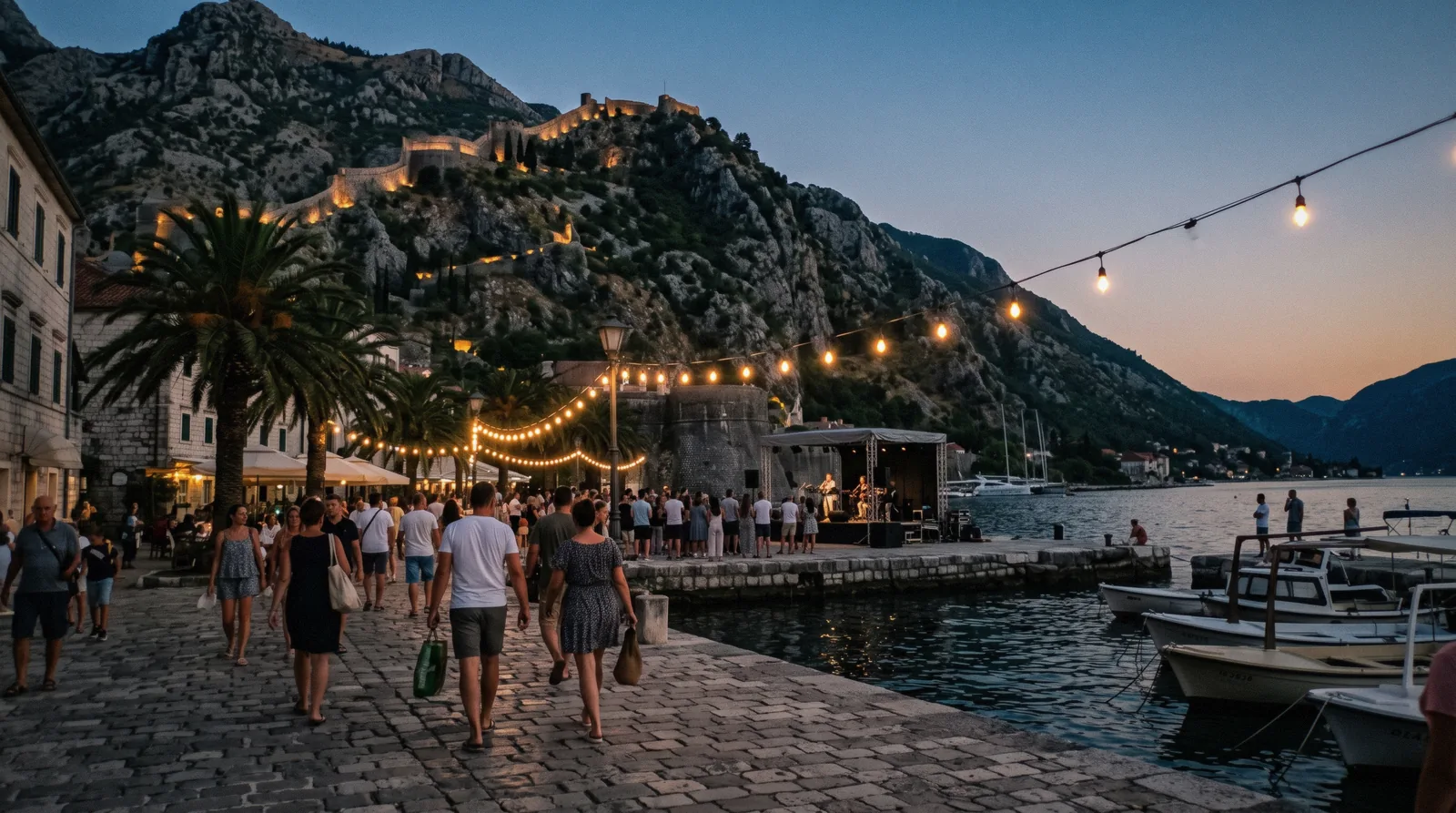
Kotor Events: Carnival, Boka Night and the Town's Calendar
Kotor events run on two calendars: the festival one and the ships. Kotor's event calendar is short and loud. It runs on three beats: a February carnival that opens around the feast of the town's patron saint, a summer carnival in late July or August, and Bokeljska Noć, the lantern-lit boat parade that fills the bay on a late-August Saturday. Around them sits a fourth calendar the town does not choose for itself: the cruise schedule, with about 523 calls in 2026. This page tells you when each event happens, how much of the town they take over, and how to build a trip around them. For the days in between, start at things to do and Kotor at night. The full guide lives on Kotor City Guide.
Quick answer The answer first, then the details that decide it
Kotor's carnival season runs in February, traditionally opening around St Tryphon's feast day on 3 February and closing with a main parade. An International Summer Carnival follows in late July or August. Bokeljska Noć, the Boka Night boat parade with fireworks, lands on a late-August Saturday. The 2026 edition is expected on Saturday 22 August. Exact dates move every year and sources disagree, so confirm on the official tourism channels before booking. Everything is free to watch from the streets or the quay.
Key takeaways
- The next stop after this page: [](/kotor-events/).
- The full guide lives on Kotor City Guide.
- The full guide lives on Kotor City Guide.
The February Carnival
The town's oldest party. It opens around the feast day of St Tryphon, Kotor's patron saint, on 3 February, and closes with a main parade. Masks, music and processions take over the old town lanes.
What It Is And When It Runs
The carnival belongs to Kotor's Venetian inheritance. Venice ruled the town from 1420 to 1797, and masked carnival culture came with it. The modern season runs through February, traditionally opening around 3 February, St Tryphon's feast day, when the cathedral that keeps the saint's relics draws the town.
The season closes with a main parade. Here is the honest problem: sources differ on the exact dates. Published calendars for the same year have given a range opening as early as 6 February and as late as 14 February, closing anywhere from mid-February to the start of March.
The dates move every year because the season follows the church calendar. No single official page publishes a fixed schedule in a form every outlet agrees on. So treat 3 February as the anchor, expect parades on weekends through the month, and confirm the main parade date on the official tourism channels before you commit.
The cathedral of Saint Tryphon itself is worth an hour regardless, admission about €4 ($4.56), open daily roughly 09:00-19:00 in season.
| Fact | Detail |
|---|---|
| Season | February |
| Traditional opening | Around St Tryphon's feast day, 3 February |
| Close | A main parade at the end of the season |
| Published 2026 ranges | Sources differ: openings from 6 February to 14 February, closings from mid-February to 1 March |
| Cost to watch | Free |
| What to do | Confirm exact dates on official tourism channels before booking |
Is Kotor Busy During Carnival?
Busy, yes. Packed, no. February is a shoulder month by every measure the weather record offers: the average high is 11.9C and rain runs about 240 mm for the month.
The cruise fleet thins out in winter, so the crowd you meet is mostly day visitors from Budva and the coast plus a carnival crowd. The old town is small, about 1,360 people live inside the walls, so even a parade route feels full fast. Book where to stay early for carnival weekends, and read Kotor in February for the honest weather picture.
February rain is real, so keep the rainy day plans in your pocket: the Maritime Museum charges €4 ($4.56) and the cathedral sits two lanes away.
- Average February high: 11.9C
- Average February rain: about 240 mm
- Cruise traffic: far thinner than summer
- Crowd character: parade days fill the old town lanes, weekday mornings stay calm
The International Summer Carnival
A second carnival season arrives with the high summer, in late July or August, when the town is already at its busiest.
Dates And The Crowd Trade-Off
The International Summer Carnival follows in late July or August, with parades and masked groups through the old town. As with the February edition, exact dates move every year and the sources differ. That matters more in summer than in winter, because late July and August are already the town's peak.
The average high sits at 29.6-29.7C, the cruise schedule is at full tilt, and the lanes between the Sea Gate and Arms Square fill from mid-morning on ship days. If the summer carnival is your target, book accommodation well ahead and plan your sightseeing for early mornings. The walls climb, 1,350 steps to the fortress, is best done before the parade crowds arrive.
Our best time to visit page lays out the trade-off between event dates and shoulder-season calm.
Bokeljska Noć, The Boka Night Boat Parade
The bay's own festival. Decorated, lantern-lit boats process across the water under fireworks, on a late-August Saturday.
What Happens At Boka Night
Bokeljska Noć is a procession of decorated boats on the bay, lit with lanterns, ending in fireworks. It is the nautical cousin of the carnival: the town's seafaring identity put on the water for one Saturday night. The 2026 edition is expected on Saturday 22 August.
Expected is the right word, because the date is a late-August Saturday chosen each year and confirmed late. Watch from the town quay, from the walls if you have already paid the €15 ($17.12) daytime entry, or from a terrace on the Kotor waterfront. The best vantage for the full sweep of boats is across the water or from a boat itself.
If you want to be on the bay that week anyway, the Boka Bay full-day guided cruise with swim stop gives you the water-level feel for a fraction of the evening's price, at US$29.00 for eight hours.
| Fact | Detail |
|---|---|
| Event | Bokeljska Noć (Boka Night) |
| What | Procession of decorated, lantern-lit boats on the bay with fireworks |
| When | A late-August Saturday each year |
| 2026 expected date | Saturday 22 August, to be confirmed |
| Cost to watch | Free from the shore |
| Best backup | A boat-based view on any other evening of the year |
Where The Boats Parade
The procession runs on the bay water directly off the old town, between the town quay and the open bay toward Dobrota. The pier sits about 100 m from the old town walls, so the whole waterfront becomes a viewing gallery. Arrive early for a quay spot on the sea side of the Sea Gate.
If you want the geometry of the shoreline before you go, our map of Kotor marks the Sea Gate, the cruise terminal and the Dobrota stretch of water where the boats gather.
Fašinada And The Other Fixed Dates
One bay custom never moves: every 22 July at sunset, residents row out to Our Lady of the Rocks and throw stones at the island to widen it.
Fašinada, Every 22 July
The fašinada is the bay's oldest unbroken custom. Our Lady of the Rocks is an artificial island of 0.38 ha built over centuries from rocks and scuttled ships loaded with stone. Seamen laid a rock on the pile after each successful voyage.
The custom continues every 22 July at sunset, when a procession rows from Perast and drops stones. The island lies off Perast, 12 km from Kotor by the coast road. On other days of the year you reach it by water taxi from the Perast quay, about €5 ($5.71) return, with the island admission at €5 ($5.71) per guest in cash since April 2026 and a dress code on the island.
If the fašinada is your reason for coming, sleep in Perast or plan a late return to Kotor. It is the one date on this page that never shifts.
The Other Calendar: Cruise Ships
Kotor's biggest recurring event is not a festival at all. It is the cruise schedule, and in 2026 it brings about 523 calls from roughly 85 ships.
How The Cruise Calendar Shapes Your Day
The Port of Kotor calls itself the third cruise destination in the Adriatic after Venice and Dubrovnik. Ships must pass the Verige Strait, only 340 m wide at its narrowest, to reach the pier, so arrival times slip when traffic stacks up. About 41 calls land in September, making it the densest single month in the schedule.
On a two-ship day the old town lanes pack by mid-morning and the walls ticket line grows. Our full cruise port guide explains the terminal, which sits a 2-5 minute walk from the Sea Gate. The practical play for festival visitors: check the ship schedule for your dates, do the walls and the cathedral early, and save the waterfront for the evening when the gangways pull up.
| Cruise fact | Figure |
|---|---|
| Calls scheduled for 2026 | About 523 |
| Ships involved | About 85 |
| Calls in September alone | About 41 |
| Pier to Sea Gate | 2-5 minute walk, about 100 m |
| Bottleneck | Verige Strait, 340 m wide at its narrowest |
A Month-By-Month Anchor Table
Only the months with a sourced event are listed. Everything else in the year is cruise traffic and weather, which the Kotor weather and cruise port pages cover. The gaps are honest ones: nobody publishes a full official events calendar that every source agrees on.
| Month | What is on |
|---|---|
| February | Carnival season, opening around St Tryphon's feast day on 3 February, closing with a main parade. Exact dates differ between sources |
| 22 July | Fašinada at sunset, the stone-throwing procession to Our Lady of the Rocks from Perast |
| Late July to August | International Summer Carnival. Exact dates move and sources differ |
| Late August | Bokeljska Noć, the lantern-lit boat parade with fireworks. The 2026 edition is expected on Saturday 22 August |
| September | The densest cruise month, about 41 calls |
Planning A Trip Around An Event
Three practical rules make an event trip to Kotor work.
Book, Then Confirm, Then Book Again
Because the carnival and Boka Night dates are confirmed late, the safe sequence is: hold refundable accommodation, wait for the official confirmation, then lock flights. Montenegro uses the euro unilaterally, so event weekends price like eurozone ones even though the country is not in the eurozone. For flights, Tivat Airport is about 5 km from town and Podgorica Airport about 65 km.
On the ground, the getting around page covers the pedestrian old town and the buses along the bay.
- Hold refundable rooms before dates are confirmed
- Confirm carnival and Boka Night dates on official tourism channels
- Expect the highest demand of the year on the Boka Night Saturday and carnival parade weekends
- Budget in euros, the local currency since Montenegro adopted it unilaterally
What Nobody Publishes
Here is the negative finding that matters. No single official page publishes a complete, authoritative Kotor events calendar. Carnival dates differ between sources for the same year.
Boka Night dates are confirmed close to the event. This is why this guide prints ranges and expected dates instead of pretending to precision. Any site giving you an exact carnival schedule months ahead is guessing.
Treat the 3 February opening anchor and the late-August Saturday for Boka Night as planning tools, not guarantees, and confirm before you spend money.
The festivals themselves cost nothing to watch. These are the paid days that make the trip around them worthwhile.
Festival days leave plenty of hours. These are the pieces that fill them.
The carnival parades run through streets built between the Venetian years of 1420 and 1797, a UNESCO site since 1979 and free to walk.
1,350 steps and about 280 m of climb to San Giovanni, entry €15 ($17.12) in the main season. Go early on festival days.
Event weekends fill the tavernas. Our guide covers the bay kitchen of pršut, black risotto and grilled fish.
When is the Kotor carnival?
The carnival season runs in February, traditionally opening around St Tryphon's feast day on 3 February and closing with a main parade. Exact dates move every year and sources differ. Some calendars for the same year have shown openings between 6 and 14 February and closings from mid-February to 1 March. Confirm on the official tourism channels.
When is Bokeljska Noć?
It falls on a late-August Saturday each year. The 2026 edition is expected on Saturday 22 August. Expected is the operative word: the date is confirmed close to the event, so check the official channels before booking travel.
What happens at Boka Night?
A procession of decorated, lantern-lit boats crosses the bay off the old town, ending with fireworks. It is free to watch from the town quay, and the waterfront near the Sea Gate fills early on the night.
Is Kotor busy during carnival?
Busy on parade days, calm between them. February's average high is 11.9C and cruise traffic is thin, so the crowds come from the carnival itself rather than from ships. Book carnival weekends early and expect the old town lanes to fill when a parade runs.
Where do the boats parade in Kotor?
On the bay water directly off the old town, between the town quay and the open water toward Dobrota. The pier sits about 100 m from the old town walls, so the whole waterfront works as a viewing gallery.
How much do Kotor's festivals cost?
Nothing to watch. The carnival parades, the summer carnival and Boka Night are all free from the street or the quay. The priced extras are the sights around them, like the walls at €15 ($17.12) and the cable car at €25 ($28.53) return.
Events on Film
Three videos that show the place before you go. They load from YouTube only when you press play.
Kotor Montenegro Cruise Port Guide
A walk or ride through the subject of this page.
Video: Irish WandererKotor Montenegro Carnival ,Can’t Believe We Saw This!
A walk or ride through the subject of this page.
Video: WePlusThreeeKotor Montenegro Cruise Port Travel Guide
A walk or ride through the subject of this page.
Video: Travel DayTrip IdeasVideos load from YouTube only when you press play.
We may earn a commission if you book through one of our links, at no extra cost to you. Full affiliate disclosure