 Kotor City Guide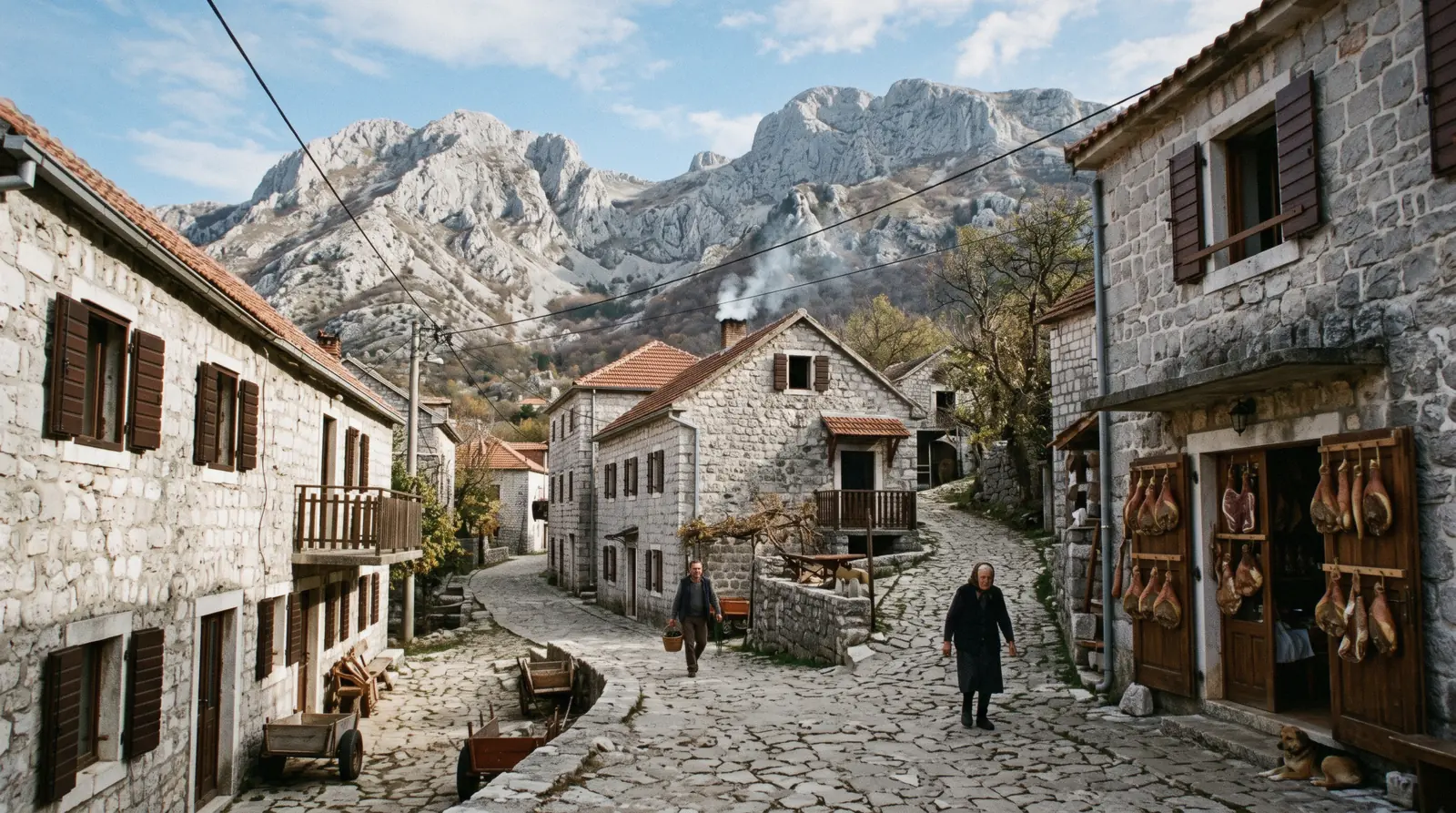
Njeguši and the 25 Hairpins: the Road That Built Montenegro
Two things share this mountain and each explains the other. The Kotor serpentine is the old wagon road Austria-Hungary carved up Mount Lovćen between 1881 and 1884 to reach the then-capital Cetinje. It carries 25 numbered 180-degree hairpins and about 75 further turns, and it takes 30 to 45 minutes to climb from Kotor to hairpin 25. Halfway up, at around hairpin 21, the road passes Njeguši village, the birthplace of Montenegro's poet-prince Petar II Petrović-Njegoš and the home of the country's most famous food, wood-smoked njeguški pršut. This page covers the road, the village, the ham, and the three ways to take the hairpins on: your own car, a bike over the top, or a van with someone else driving. For the mausoleum and the gondola at the top of the same mountain, see our Lovćen National Park and Kotor cable car pages. The full guide lives on Kotor City Guide.
Quick answer The answer first, then the details that decide it
The serpentine is the free, paved, hairpin road from Kotor up to Njeguši village and on to Cetinje. The village costs nothing to walk. A pršut and cheese plate in a family tavern is paid at the table, and no source publishes a fixed tasting price, so treat menu prices as informal. The drive from Kotor to the top of the numbered hairpins takes 30 to 45 minutes. If you would rather not drive, the Lovćen cable car, Njeguši and Cetinje day tour does the whole loop by van for US$73, and the 25-turns downhill bike ride rides the hairpins down instead of up for US$126.94. Budget half a day. Go early or late to have the viewpoints to yourself.
Key takeaways
- : $113.00 - the catches and the free-cancellation window on Montenegro highlights day trip with lake cruise.
- : $113.00 - the catches and the free-cancellation window on Montenegro highlights day trip with lake cruise.
- The next stop after this page: [](/njegusi/).
Key facts
Opening hours
| All year | not stated–not stated |
|---|
Closed The road and village are open all year. hours for individual taverns and the Njegoš birthplace museum are not stated. The Njegoš Mausoleum up at Jezerski vrh closes for visits from 16 November to 10 April.
Admission
- Adult
- Free. The village and the road charge nothing.
- Reduced
- not stated
- Free
- Walking the village street is free.
Planning it
- Time needed
- 30-45 minutes to drive from Kotor to hairpin 25. Allow a half day for the village, a tasting and the viewpoints.
- Book ahead
- Optional — walk-up usually fine
- Address
- Njeguši village, above Kotor on the old Lovćen road toward Cetinje. No street address is published.
Tickets and Prices: What You Actually Pay. Tour prices are the platform's listed US dollars. the platform bills in your own currency. The village itself is free. Nobody publishes a fixed price for tavern tastings.
Drive the hairpins, ride them down a bike, or let a van do both?
| Option | Price | Time | Best for | Book |
|---|---|---|---|---|
| For anyone with a rental car and steady nerves. | For anyone with a rental car and steady nerves. | Free to cancel up to 24 hours before | Check Availability | |
| For visitors without a car, and anyone who would rather watch the hairpins than drive them. | For visitors without a car, and anyone who would rather watch the hairpins than drive them. | Free to cancel up to 24 hours before | Check Availability | |
| For people who measure a road in grins per hairpin. | For people who measure a road in grins per hairpin. | Free to cancel up to 24 hours before | Check Availability |
Tour prices are the platform's listed US dollars. the platform bills in your own currency. The village itself is free. Nobody publishes a fixed price for tavern tastings. Figures current in Q3 2026.
Ways Up the Mountain
The Serpentine's Story
The road exists because empires needed to move soldiers, and it survived because Montenegro needed to move everything else.
Built to Reach the Old Capital
Between 1881 and 1884, while Montenegro was still an independent principality ringed by empires, Austria-Hungary built a wagon and military route over Mount Lovćen from the Bay of Kotor to Cetinje. Before it, the capital was reached on foot and by mule. The engineers solved a mountain that rises more than 900 metres above the sea with geometry: 25 numbered 180-degree hairpin turns stacked on the mountainside above Kotor, plus roughly 75 further bends along the whole route.
The number of switchbacks is the engineering, and the engineering is the sight. Cetinje it was built to reach sits on the other side of the mountain, and the road remains the classic way between the two.
Counting the Hairpins
The numbered hairpins run from the bottom above Kotor up toward the village. Each numbered turn is a full 180 degrees, banked and walled, and the stone parapets date from the original construction. The signs let you track progress, which turns the drive into a slow countdown and gives every pull-in a number of its own.
Hairpin 25 sits near the top of the numbered stretch, reached from Kotor in 30 to 45 minutes of steady climbing. Beyond it the road continues its roughly 75 gentler bends toward Njeguši and over the mountain. Our map of Kotor and the bay marks the bottom of the climb, and our best views of Kotor page names the pull-ins worth stopping for.
The Road That Built a Country
The title of this page is not decoration. The road connected the bay's trade to the mountain capital, and the mountain capital to the sea, at exactly the moment Montenegro was consolidating as a state. It also runs through the village that produced the state's most important figure.
Petar II Petrović-Njegoš, Montenegro's poet-prince, was born in Njeguši in 1813 and died in 1851, and he is now buried in the mausoleum on the summit above the road. The royal Maritime Museum down in Kotor's old town tells the sea half of that story. The road tells the mountain half.
Njeguši Village
A single stone street at around hairpin 21, and the family home of Montenegro's most famous son.
Njegoš's Birthplace
Petar II Petrović-Njegoš was Montenegro's prince-bishop and its greatest poet, and the stone house where he was born in 1813 still stands in the village. The National Museum runs it, and a combined ticket covers both the birthplace and the mausoleum where he lies, so if you are continuing up the mountain the pair ticket is the one to ask for. Opening hours for the birthplace are not stated in the sources we check, so ask at the door or at the tourist information point by the Sea Gate before you drive up.
The house is small. Half an hour inside, and the rest of your time in the village belongs to the taverns and the view back down the hairpins you just drove.
The Street and the Stone Houses
Njeguši is built the way mountain villages here were always built: heavy stone roofs, thick walls, and one main street where everything happens. Taverns and family houses line that road, smoke drifting from the drying rooms where the ham hangs. There is no entrance fee, no ticket office and no queue.
You park, you walk, you eat. The village's fame rests on two pillars, the birthplace and the food, and the food is the reason most plates in Kotor's restaurants carry the village's name.
The Pršut Table
Njeguški pršut is the dish that made the village a name on menus across the coast.
What Njeguški Pršut Is
Pršut is dry-cured ham, and the Njeguši version is dry-cured and wood-smoked, aged in the village's mountain air. That air is the ingredient nobody can copy: the cold, dry wind that sweeps over Lovćen does the curing work that other climates need salt and machinery for. The ham is eaten with Njeguši cheese and bread, and that plate, with maybe a glass of something local, is the classic village lunch.
Family taverns on the main road run tastings. No source we check publishes a fixed tasting price, so read the menu at the table and treat it like any village lunch rather than a ticketed experience.
Where the Tastings Happen
The tastings happen in family taverns on the main road. We name none of them here because no citable ranking covers them and no official list exists in the sources we check, and we would rather send you to a street of competing family kitchens than invent a winner. That is genuinely good news for a visitor: you can look at the tables, smell the smoke, and choose.
If you want the guided version of Montenegrin food, the Kotor food tour tastes pršut, cheese, wine and honey brandy down in town, and our where to eat guide covers the bay's taverns. The mountain version is simpler. Drive up, sit down, order the ham.
Driving the Serpentine Safely
The road is narrow, paved and perfectly drivable. The mistake people make is treating it like a racetrack.
Rental Cars and the Road
A rental car is what opens Njeguši, Cetinje and Lovćen National Park in one day, and the serpentine is narrow but paved, so ordinary rental cars do it fine. Take it in a low gear on the way down and let the engine brake carry you rather than riding the brakes through 25 turns. Buses and tour vans use the same road, and some hairpins are tight enough that a meeting vehicle means one of you reverses to a wide spot, so keep left into the wall side and expect it.
Our car rental guide covers picking up a car, and getting around Kotor covers the alternatives if you would rather not drive at all.
Is It Dangerous?
It is a mountain road with drop-offs and stone parapets, not a stunt drive. The hazards are the ordinary ones done at altitude: narrow width at the hairpins, oncoming buses, cyclists on the descents, and fog when the mountain wears cloud. Drive slowly, use the pull-ins for photos instead of stopping in the road, and start the climb with fuel and daylight to spare.
In winter the upper sections can hold ice when Kotor sits in sunshine below, so check conditions that morning. None of this needs special courage. It needs the pace of a delivery driver, which is also the pace at which the views are best.
The Car-Free Alternatives
Two tours solve the road for people who did not rent a car. The Lovćen cable car, Njeguši and Cetinje day tour takes the whole route by air-conditioned minivan with a guide, adding the gondola and the old capital, and its operators remind you to bring covered shoulders and knees for the monastery stops. The 25-turns downhill bike ride inverts the problem: the cable car carries you and the bike up, and you descend all the hairpins on tarmac with brakes instead of legs, guided or self-guided. And if you only want the viewpoints without the village, the hop-on hop-off bus runs the serpentine's viewpoint stretch above town every 20 to 25 minutes on a one-day ticket.
How Much Time to Allow
The honest answer depends on whether the ham is involved.
Time Budgets for the Trip
The drive itself is short. Everything else, the tavern lunch, the viewpoints, the onward push to Cetinje or the mausoleum, is what turns it into a day. Use the table to pick your shape of day, then check our one-day, two-day and three-day itineraries to see where the mountain fits.
| Trip | Time needed | Notes |
|---|---|---|
| Kotor to hairpin 25, viewpoints only | 30-45 minutes of driving | One-way driving time up the numbered hairpins. |
| Drive up, pršut plate in Njeguši, drive down | Half a day | The standard trip from Kotor. Add time at the pull-ins. |
| Village plus Njegoš birthplace | not stated | Museum hours are not published in the sources we check. Ask locally. |
| Njeguši plus Cetinje in one day | Full day | The road continues over Lovćen to the old capital. |
| Guided cable car, Njeguši and Cetinje day | 7h 30m | The van tour's stated duration. |
| Downhill bike over the hairpins | 4 hours | The bike tour's stated duration, gondola ascent included. |
Dos and Don'ts
A short list of the things visitors get wrong on this road.
Do
- Do stop at the numbered pull-ins for photos instead of braking in the road.
- Do eat the pršut in the village where the smoke and the mountain air do the curing.
- Do start early, before the tour vans and the hop-on bus own the hairpins.
- Do bring cash for tavern lunches, the sources publish no card-policy figures for the village.
- Do consider pairing the village with the mausoleum, since a combined ticket covers the birthplace and the mausoleum.
Don't
- Don't drive the hairpins at speed. The road is a working route for buses and bikes.
- Don't plan the upper mountain in winter without checking: the mausoleum closes for visits from 16 November to 10 April.
- Don't expect facilities at every viewpoint. Plan stops around the village.
- Don't skip the village because you took the gondola up. The road and the street are half the story.
Five Things Not Everybody Knows
The details that make the drive more than a drive.
The Numbers on the Signs Are the Engineering
Each of the 25 numbered turns is a full 180 degrees, built between 1881 and 1884 as a wagon and military route. The numbering was the surveyors' bookkeeping, and it survives as the most photographed counting exercise on the Montenegrin coast.
The Road Was Built by Austria-Hungary for a Country It Did Not Control
The wagon road over Lovćen to Cetinje was an Austro-Hungarian military project, running into the independent Montenegrin capital. The mountain above the bay was the frontier, and the road was the argument.
There Are About 75 More Turns Nobody Counts
The famous numbered hairpins are only the steep part. The full route adds roughly 75 further bends toward the village and over the mountain, which is why 30 to 45 minutes of driving covers just the numbered stretch.
The Ham Is Cured by the Wind
Njeguški pršut is wood-smoked and then aged in the village's mountain air, which is cold and dry enough to do the curing. The plate you eat at hairpin 21 is a product of the same climate you drove through to get there.
The Village Is Free and the Museum Pairs Up
Walking Njeguši costs nothing, and the National Museum sells a combined ticket covering Njegoš's birthplace and the summit mausoleum, so the poet-prince's two addresses can share one ticket.
Nearby
Lovćen National Park
The mountain the road crosses. The park gate, the 461 steps and Njegoš's mausoleum sit above the village, with a mausoleum entry reported at €8 ($9.13) for adults and combined tickets with Cetinje museums reported at about €20 ($22.82).
Cetinje
The old royal capital the serpentine was built to reach, founded in 1482, with the royal palace museum and the monastery that keeps the right hand of St John the Baptist.
Kotor Cable Car
The gondola that skips the road entirely: a return ticket costs €25 ($28.53) for adults and the ride takes 11 minutes to the Krstac ridge above the hairpins.
Njeguši and the Serpentine: Questions
How do you get from Kotor to Njeguši?
By car, up the serpentine: 30 to 45 minutes of driving from Kotor to the top of the numbered hairpins, with the village on the same road. Without a car, the Lovćen cable car, Njeguši and Cetinje day tour reaches the village by van, or you can ride down to it on the 25-turns downhill bike tour. See our getting around page for the full picture.
How many hairpins does the Kotor serpentine have?
25 numbered 180-degree hairpins, plus about 75 further turns along the rest of the route. The road was built between 1881 and 1884 under Austria-Hungary as a wagon and military route over Lovćen to Cetinje.
What is Njeguši famous for?
Two things. It is the birthplace of Petar II Petrović-Njegoš, Montenegro's poet-prince, whose stone birth house stands in the village under a combined National Museum ticket. And it is the home of njeguški pršut, the wood-smoked dry-cured ham aged in the village's mountain air, eaten with Njeguši cheese in the family taverns on the main road.
Can you drive the serpentine in a rental car?
Yes. The road is narrow but paved, and a rental car is what opens Njeguši, Cetinje and Lovćen in one day. Take a low gear on the descent and expect to meet buses and tour vans at the tightest turns. Our car rental page covers the practicalities.
Is the serpentine road dangerous?
It is a normal mountain road with drop-offs and stone parapets, not a dangerous one, if you drive it slowly. The real risks are fog, ice in winter on the upper sections, and stopping in the road instead of the pull-ins. If the road worries you, the guided van day puts someone else behind the wheel.
Njeguši on Film
Three videos that show the place before you go. They load from YouTube only when you press play.
Exploring Njeguši Village: Prosciutto, Rakia, And Festivals in Montenegro
A walk or ride through the subject of this page.
Video: travelmvmtNjeguš Prosciutto, Njeguši, Montenegro
A walk or ride through the subject of this page.
Video: Travel With Lynn & JesenkoNjeguši Prosciutto
A walk or ride through the subject of this page.
Video: Andreas HirschVideos load from YouTube only when you press play.
Prices, hours and terms are set by the venue or operator and confirmed at checkout.
We may earn a commission if you book through one of our links, at no extra cost to you. Full affiliate disclosure