 Kotor City Guide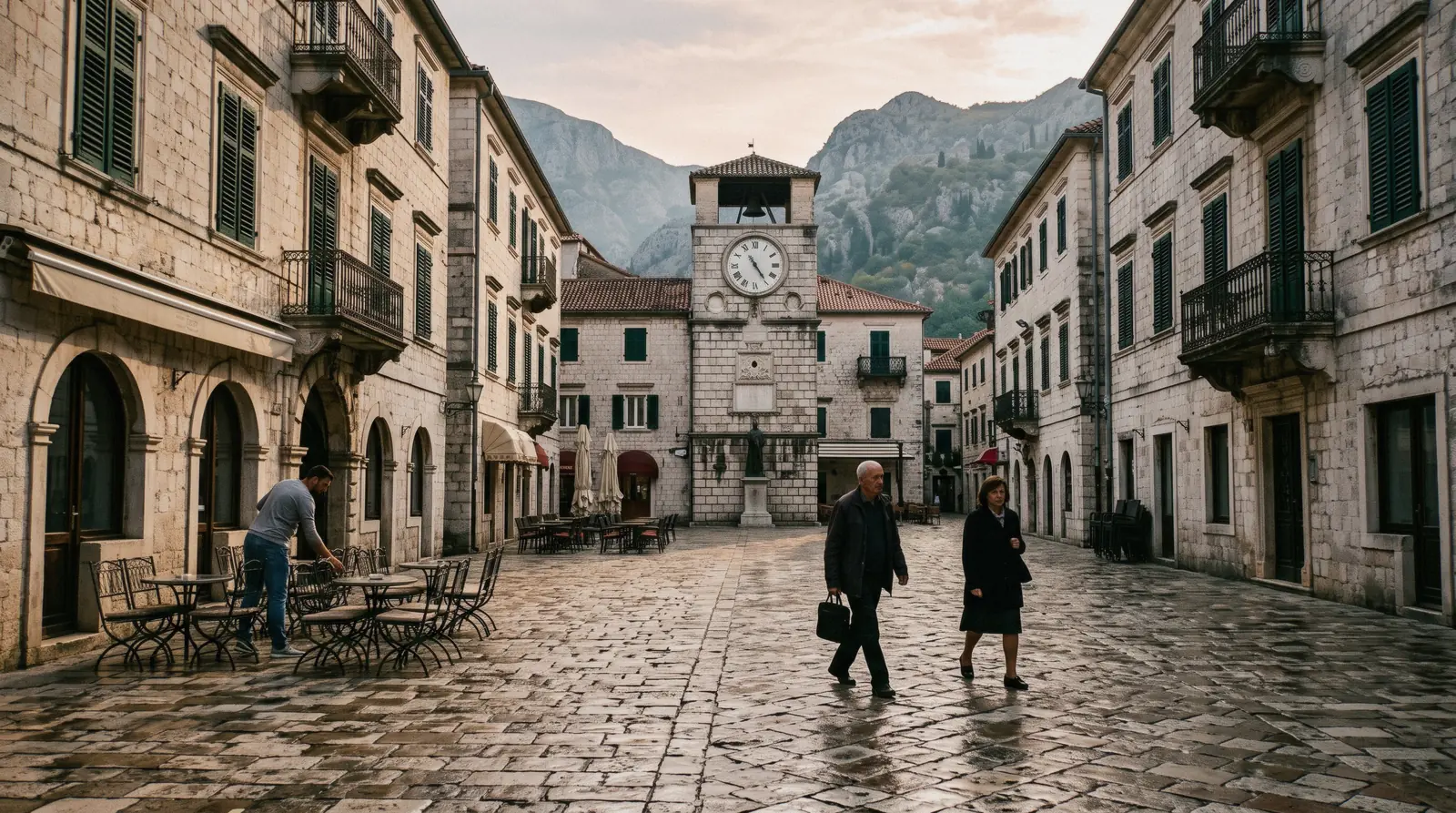
Kotor Old Town: the Walled City, Gate by Gate
Kotor old town is the reason most people come to this corner of Montenegro. It sits at the innermost point of the Bay of Kotor, ringed by walls that run about 4.5 km and climb straight up the mountain behind it. The town has been on the UNESCO World Heritage list since 1979, the same year an April earthquake damaged it, and the fortifications joined UNESCO's Venetian Works of Defence listing in 2017. Venice ruled Kotor from 1420 to 1797 and left the arcaded squares, the baroque facades and the lion-carved gates that you will photograph all day. Only about 1,360 people actually live inside the walls, on the 2023 census, which is why the lanes empty so completely at night. This page walks you through the old city gate by gate, square by square, in a route you can follow without a guide, and tells you where every euro goes. If you would rather hear it from a local first, both the 70-minute old town walking tour and the 90-minute guided walking tour start at the Sea Gate and cover the same ground as the route below. The full guide lives on Kotor City Guide.
Quick answer The answer first, then the details that decide it
Kotor old town is free to enter and free to walk, day and night. Give it two hours for the five headline stops, half a day with the two museums, or a full day if you add the walls climb. Enter through the Sea Gate on the water side, the main western gate built in 1555. The three paid sights inside and above the town are the walls at €15 ($17.12), St Tryphon's Cathedral at about €4 ($4.56) and the Maritime Museum at €4 ($4.56). Montenegro uses the euro even though it is not in the eurozone, so cash and card work exactly as you expect. English is widely spoken, and the tourist info point stands by the Sea Gate and on Arms Square. Start early or come late in the day, because the lanes fill fast when the cruise passengers arrive.
Key takeaways
- Entry: free, no ticket, no gate
- Paid sights: walls €15 ($17.12), cathedral about €4 ($4.56), Maritime Museum €4.
- Main gate: the Sea Gate, built 1555, two minutes from the cruise terminal.
Key facts
Opening hours
| The old town itself | always open–always open |
|---|---|
| St Tryphon's Cathedral, in season | roughly 09:00–roughly 19:00 |
| Maritime Museum, main season | not stated (summer evenings extend hours)–not stated |
| Maritime Museum, winter from October 15 | short days, exact hours not stated–not stated |
Closed Cathedral opens daily in season, with Sunday mass in the morning. Museum closing days not stated.
Admission
- Adult
- Old town free. Walls €15 ($17.12). Cathedral about €4 ($4.56), sources range €2.50-5. Maritime Museum €4 ($4.56), children €1 ($1.14).
- Reduced
- Maritime Museum children €1 ($1.14). Other concessions not stated.
- Free
- Walking the old town, the squares and the lanes is free. Walls entry free for children under 12.
Planning it
- Time needed
- Two hours for the highlights, half a day at an easy pace, a full day with the walls climb.
- Book ahead
- Recommended — a few days
- Address
- Kotor old town (Stari Grad), Kotor 85330, Montenegro. Main entrance: the Sea Gate on the western side.
Tickets and Guided Walks Compared
Tour prices are as listed on the booking platform. Sight prices are the door prices reported by our sources. The cathedral door price is small and adjusted occasionally, so sources range from €2.50 ($2.85) to €5 ($5.71) and we write about €4 ($4.56) rather than a fake exact figure. No official page publishes the walls price, which is a gate price.
Walking the old town needs no ticket at all, so the real decision is whether to add a guided walk and which of the two to pick. Both tours below start at the Sea Gate, both are in English, and both cancel free up to 24 hours before the start. The platform bills in your own currency at checkout.
| Option | Price | What you get | Cancel | Book |
|---|---|---|---|---|
| Anyone happy to follow the route on this page. The town is small and every stop below is linked to a deeper page. | Anyone happy to follow the route on this page. The town is small and every stop below is linked to a deeper page. | not stated | Official site | |
| Visitors with a tight schedule who want the essentials and still have the afternoon free for the walls or the cable car. Run by Montenegro Adventures DMC. | Visitors with a tight schedule who want the essentials and still have the afternoon free for the walls or the cable car. Run by Montenegro Adventures DMC. | Free to cancel up to 24 hours before | Check Availability | |
| Anyone who wants the slower, deeper version for less money. The only climb is about twenty steps, run by KBT - Active Tours. | Anyone who wants the slower, deeper version for less money. The only climb is about twenty steps, run by KBT - Active Tours. | Free to cancel up to 24 hours before | Check Availability |
Tour prices are as listed on the booking platform. Sight prices are the door prices reported by our sources. The cathedral door price is small and adjusted occasionally, so sources range from €2.50 ($2.85) to €5 ($5.71) and we write about €4 ($4.56) rather than a fake exact figure. No official page publishes the walls price, which is a gate price. Figures current in Q3 2026.
Old Town Tours Worth Booking
Two guided walks belong to this page. Both meet at the Sea Gate, both run in English, and both cancel free up to 24 hours ahead. Pick by the time you have, not the price, because the longer walk is the cheaper one. The deeper of the two old-town walks. An hour and a half at a slower pace, with twenty steps of climbing as the only effort, which makes it the right choice if anyone in your group dislikes stairs. The shortest guided intro to the walled town, run by a Kotor agency. Seventy minutes covers Arms Square, St Tryphon's and the maritime corners, and leaves the rest of your day free for the walls or the cable car. If you would rather eat your way through the lanes, the Kotor food tour also starts in front of the Sea Gate. For everything beyond the walls, see our Kotor tours hub.
The Timeline: What Built This Town
Kotor's old town is not the work of one century or one ruler. It has been fortified since late antiquity, passed through Serbian and Venetian hands, and was rebuilt twice after earthquakes nearly destroyed it. These ten dates explain almost everything you will see.
Ten Dates That Explain the Old Town
Stand in any square and you are looking at layers from at least six of these years.
| Year | What happened |
|---|---|
| 535 | A fortress stands above the town from Justinian's fort, the first recorded defence of the site |
| 809 | The church of St Tryphon is founded, giving the town its patron saint and its cathedral |
| 1195 | St Luke's church is built, the building locals say never fell in an earthquake |
| 1420 | Venice takes Kotor and begins nearly four centuries that shape the town's architecture |
| 1555 | The Sea Gate, the town's main western entrance, is built in the Venetian era |
| 1602 | The baroque Clock Tower rises on Arms Square, leaning slightly toward the Sea Gate ever since |
| 1667 | The great earthquake nearly destroys the town, wrecks Dubrovnik and badly damages St Tryphon's Cathedral |
| 1797 | Venice falls and Venetian rule over Kotor ends after 377 years |
| 1979 | An April earthquake damages the town in the very year UNESCO inscribes the region on the World Heritage list |
| 2017 | The fortifications join UNESCO's Venetian Works of Defence listing |
Gate by Gate: How to Enter the Old Town
The walls around Kotor have several gates, but most visitors use one. Knowing which gate does what saves you a confusing first ten minutes, because the lanes inside do not run in a grid and GPS is unreliable between the stone walls.
The Sea Gate (Morska vrata)
The Sea Gate is the old town's main western entrance, built in 1555 in the Venetian era, and it opens directly onto the Square of Arms. It was the water gate: ships once tied up outside, and today the cruise pier sits about 100 m away, so anyone arriving by ship walks two to five minutes to reach it. The gate carries the Venetian lion and the stones still show the passage of centuries of rebuilding.
Practically, it is the landmark to give any taxi or tour meeting point, since both guided walks on this page meet here. The tourist info point stands nearby, so if you want a paper map or need to register a private-stay residence tax, start at this gate. On our Kotor map it is the western anchor of the whole walled town, and the 70-minute walking tour begins at it daily.
The North Gate and the River Gate
The old town has other entrances along the Skurda side and the land walls, including the north gate where the walls ticket office sits for anyone climbing to San Giovanni fortress. Our sources describe these gates without giving a full inventory of names and dates for each, so we will not invent them. What matters practically is this: if you are walking in from the bus station or from Dobrota along the shore, you will arrive on the northern or eastern side and can slip in through the smaller gates, which are quieter and faster than the Sea Gate when a ship is in.
The north gate is also the practical entrance for the walls climb, since the ticket office there sells or checks the €15 ($17.12) walls ticket. If you arrive that way, walk into town first and come back to the walls entrance after you have seen the squares. The lanes between the north gate and Arms Square are among the calmest in the whole old town.
Square by Square: the Walking Route
Here is the route we would walk, in order, starting from the Sea Gate. It links the five named stops below and takes about two hours without museum visits. Each stop has its own page that goes deeper.
Stop 1: The Square of Arms (Trg od oružja)
You step through the Sea Gate and you are already here. The Square of Arms is the largest square in the old town and the civic centre since Venetian times, named for the arsenal that once stood on it. Its defining building is the baroque Clock Tower, built in 1602 on the site of a medieval tower.
Look up: the tower leans slightly toward the Sea Gate, a tilt you can see with the naked eye once someone points it out. In front of it stands a medieval pillory, the stone post where wrongdoers were once chained in public. The square holds the tourist info point, so pick up a map here, and it is where the town's cafes spread their tables in the shade of the arcades.
Cruise days fill it fastest between late morning and mid afternoon. Everything on this square is free to look at, which makes it the best-value ten minutes in Kotor. When you are ready, walk south past the tower toward the cathedral, following the sound of the bells.
Stop 2: St Tryphon's Cathedral
The cathedral of St Tryphon is the old town's monument. It was consecrated in 1166, which makes it older than the Venetian era that reshaped everything around it, and it keeps the relics of Kotor's patron saint inside. The 1667 earthquake badly damaged it, and the rebuilds left the two towers famously unequal, an asymmetry you can check for yourself from any square with a view of it.
Admission is about €4 ($4.56), with sources ranging from €2.50 ($2.85) to €5 ($5.71), so treat the door price as small and occasionally adjusted. It opens daily roughly 09:00-19:00 in season, with Sunday mass in the morning, which is worth knowing if you planned a morning visit on a weekend. Our full page on the Cathedral of Saint Tryphon covers the interior, the relics and the treasury.
Give it half an hour, dress with shoulders covered as in any working church, and note that the light inside is best in the late morning.
Stop 3: St Luke's Church
St Luke's church was built in 1195 and is the most quietly remarkable building in the old town. For centuries it served Catholic and Orthodox congregations together, with two altars under one small roof, which is rare anywhere in Europe. Local tradition says it is the only building in town that survived the great earthquakes intact, including the one of 1667 that wrecked the cathedral next door and the one of 1979 that brought UNESCO inspectors in the same year.
The floor is paved with grave slabs, because the ground around the church served as a burial ground for centuries, so watch your step and read the stones. There is no ticket mentioned by any source for entering, and the church is small enough that five minutes inside is enough. It sits a minute's walk north of the cathedral, on its own little square where the shade gathers in the afternoon.
Our things to do hub ranks it among the top free sights in town.
Stop 4: The Maritime Museum
The Maritime Museum of Montenegro fills the Grgurina palace on the Maritime Square, at Trg Bokeljske mornarice 391. This is the town's memory of the Boka sailor-merchants whose ships sailed the world's routes and sent their fortunes home to build the palaces you are walking past. Admission is €4 ($4.56) for adults and €1 ($1.14) for children, which is the gentlest museum ticket on the coast.
In the main season, summer evenings extend the hours, which makes it a good late-day stop when the squares have cooled. From October 15 the winter season runs short days, and the exact 2026 hours vary by source, so check the door or our Maritime Museum Kotor page before you plan an evening around it. A practical note: the hop-on hop-off bus ticket gives 50 percent off this museum, so if you bought one for the viewpoints, show it here.
Give the museum 45 minutes to an hour.
Stop 5: The Cats' Square and the Cat Museum
Finish the route at the Cats' Square (Trg od mačaka) by the Sea Gate, because the cat is the unofficial symbol of Kotor and this square is where the theme is impossible to miss. The old town has cat shops, a cat museum, feeding stations and boxes in the lanes, and the charity Kotor Kitties organises spay-and-neuter work for the stray population, which is why the cats look healthy rather than hungry. The square sits on your way out of town, so it is the natural last stop before you decide between a swim off the waterfront, a climb up the walls, or a drink with a view of the mountain.
The cat museum inside the old town is small and cheap by local standards, though our sources do not publish its exact ticket price, so treat the door price as a small surprise. Our Cats of Kotor page tells the full story of how a port town and its ships collected a cat population, and why the locals defend it.
How Much Time to Give the Old Town
The honest answer depends on whether you are adding the walls climb, because that alone takes a couple of hours and its own legs. Here is how the visit scales.
Three Visit Lengths Compared
Times assume you arrive through the Sea Gate and follow the route on this page.
| Visit | Time needed | What fits | Who it suits |
|---|---|---|---|
| Short visit | About 2 hours | The five stops on the route above, at a brisk but honest pace, with a coffee stop on Arms Square | Cruise passengers and anyone passing through Kotor on the road south. If that is you, see our cruise port page first |
| Full visit | About half a day | The route plus the Maritime Museum, the cathedral interior and the Cats' Square at an easy pace, plus lunch | Day trippers from Budva or Tivat who want the town done properly without rushing |
| With a guide and the walls | A full day | A 70- or 90-minute guided walk, the museums, lunch, then the walls climb of about 1,350 steps to the fortress | First-time visitors staying overnight in Kotor who want the complete picture. Pair it with our 1-day itinerary |
If You Only Have One Hour
Enter through the Sea Gate, cross the Square of Arms to see the Clock Tower and the pillory, walk two minutes south to St Tryphon's Cathedral and look up at the unequal towers, then cut north to St Luke's. That loop touches the town's three defining eras in under an hour and costs nothing. If an hour is all Kotor gets, our things to do in Kotor page explains what you are leaving for next time, and the 2-day itinerary shows how to spread the rest.
Practical Notes for the Old Town
A few things our sources make clear that most visitors learn the hard way.
Money, Language and Information
Montenegro uses the euro unilaterally, though it is not in the eurozone, so prices look familiar and no currency exchange is needed if you arrive with euros. English is widely spoken inside the old town, menus and tickets included. The tourist info point sits by the Sea Gate and on Arms Square, which is convenient because that is also where both guided walks meet.
Card payment is normal in the ticketed sights, but carry some cash for small door prices and the cat museum, and note that island and boat cash rules elsewhere in the bay are stricter. For the full picture on what a Kotor trip costs, see our Kotor costs page.
When the Town Is at Its Best
The old town never closes, but its character changes through the day. Early morning, before the tours and the ship arrivals, the lanes belong to residents and the light comes straight down the narrow streets. Late afternoon into evening is the second calm window, and the town is at its most atmospheric after dark, which our Kotor at night page covers.
Midday on a cruise day is the busiest stretch, since the pier is about 100 m from the walls and passengers stream in within minutes of docking. For seasonal planning, our best time to visit Kotor page and Kotor weather page carry the month-by-month detail.
Getting There and Sleeping Inside the Walls
The old town is car-free, and you cannot drive into it, so park outside and walk. Our getting around Kotor page covers parking and the local buses, and the Kotor car rental page explains why most visitors rent for day trips rather than for the town itself. If you are flying in, Tivat Airport is the close one and Podgorica Airport the inland alternative, and coming from Croatia the Dubrovnik to Kotor page has the border-crossing realities.
Sleeping inside the walls is possible, and the stone houses make atmospheric rooms, though dragging luggage over cobbles is the trade. Compare options in Kotor hotels, our Kotor apartments page or the Kotor hostel pick.
Dos and Don'ts in Kotor Old Town
Small things that make the visit better, gathered from the practical realities our sources describe.
Do
- Enter through the Sea Gate first, so the Square of Arms becomes your mental anchor when the lanes confuse you
- Look up at the Clock Tower from the Sea Gate side and spot the lean toward the gate
- Carry some cash in euros for the small door prices at the cathedral and the cat museum
- Wear shoes that survive polished stone, because the lanes are slick when it rains in this one of Europe's wetter regions
- Book a guided walk a day ahead in season if you want one, since both tours free-cancel up to 24 hours before the start
Don't
- Don't drive toward the old town looking for parking inside the walls, because there is none and the streets were never built for cars
- Don't visit the cathedral on a Sunday morning expecting a quiet look inside, since mass comes first and the visiting hours sit around it
- Don't judge the walls ticket by online listings alone, because no official page publishes the price and the gate price is the real one
- Don't plan the whole visit between a ship's arrival and midday, when the small squares hold their maximum crowd
- Don't skip the museums because they look small, since the Maritime Museum is the only place the town's sailing story is told properly
Five Things Most Visitors Do Not Know
Every one of these comes straight from our sources, and each changes how the old town looks once you know it.
The List
- The old town's UNESCO listing arrived in the very year it was damaged: the April 1979 earthquake struck the town in the same year the Natural and Culturo-Historical Region of Kotor joined the World Heritage list (source: UNESCO World Heritage list)
- St Luke's is credited as the only building in town that survived the great earthquakes intact, and its floor is paved with centuries of grave slabs you are walking over (source: Adriatic Ways)
- The Clock Tower has been leaning slightly toward the Sea Gate since it was built in 1602 on the site of a medieval tower (source: Adriatic Ways)
- Only about 1,360 people live inside the walls on the 2023 census, fewer than the neighbouring suburb of Skaljari counts at 3,342 (source: Wikipedia, Kotor, 2023 census)
- The fortifications belong to two separate UNESCO listings: the 1979 regional inscription and the 2017 Venetian Works of Defence listing (source: Wikipedia, Kotor)
Map of the Old Town
Near the Old Town
The City Walls and San Giovanni Fortress
The walls run about 4.5 km directly above the town, and the climb of about 1,350 steps rises roughly 280 m to the fortress in 45-60 minutes. The ticket is €15 ($17.12) in the main season with about €8 ($9.13) reported in winter, children under 12 free. Start from the north gate ticket office early, since the path has no shade.
Perast and Our Lady of the Rocks
Perast sits 12 km from Kotor by the coast road, with the artificial island of Our Lady of the Rocks offshore. The boat trip is the classic bay outing, and since April 1, 2026 the island admission is €5 ($5.71) per guest in cash per operator notices. Our Perast page has the water taxi and timing details.
The Cable Car up Mount Lovćen
The gondola lifts you from Dub above Skaljari to the Krstac ridge in 11 minutes, with return tickets at €25 ($28.53) adult. It closes for wind with little notice, so check same-day status before you commit. The Kotor cable car page has the full fare and hour list.
Kotor Old Town: Questions and Answers
Is Kotor old town free to enter?
Yes. Walking the old town, its squares and its lanes costs nothing, at any hour, with no ticket or turnstile. The paid sights are separate: the city walls at €15 ($17.12), St Tryphon's Cathedral at about €4 ($4.56) and the Maritime Museum at €4 ($4.56). See our free things to do in Kotor page for more no-cost options.
How long do you need in Kotor old town?
Two hours covers the five headline stops at a brisk pace, and half a day lets you add the museums and eat properly. A full day is right if you add the walls climb, which takes 45-60 minutes up on its own. Our 1-day itinerary fits the town into a single schedule.
What is the old town's main gate?
The Sea Gate (Morska vrata), the old town's main western entrance, built in 1555 in the Venetian era. It opens onto the Square of Arms and it is about 100 m from the cruise pier, so nearly everyone arrives through it. Both guided walks on this page use it as their meeting point.
Is Kotor old town the same as Budva old town?
No. Kotor's old town is the walled city at the head of the bay, with the fortress walls climbing the mountain behind it, and Budva's old town is a smaller walled quarter down the coast. Both are worth seeing and they are about a drive apart, but Kotor's is the larger and the one with the UNESCO walls listing. If you have to choose for history, choose Kotor.
Can you drive into Kotor old town?
No. The old town is pedestrian and its lanes were never built for vehicles, so you park outside and walk in through a gate. Our getting around Kotor page covers where to leave the car, and the Kotor map shows the walking distances, which are short.
Kotor Old Town on Film
Three videos that show the place before you go. They load from YouTube only when you press play.
Kotor, Montenegro | Old Town Walking Tour 4K
A walk or ride through the subject of this page.
Video: TravelCam.KushAziKOTOR 🇲🇪 Montenegro | Scenic Old Town Walking Tour in 4K (Turn On Captions)
A walk or ride through the subject of this page.
Video: Travel with JeevanKotor, Montenegro 🇲🇪 | 4K Walking Tour Through the Old Town & Bay
A walk or ride through the subject of this page.
Video: VV labVideos load from YouTube only when you press play.
Prices, hours and terms are set by the venue or operator and confirmed at checkout.
We may earn a commission if you book through one of our links, at no extra cost to you. Full affiliate disclosure