 Kotor City Guide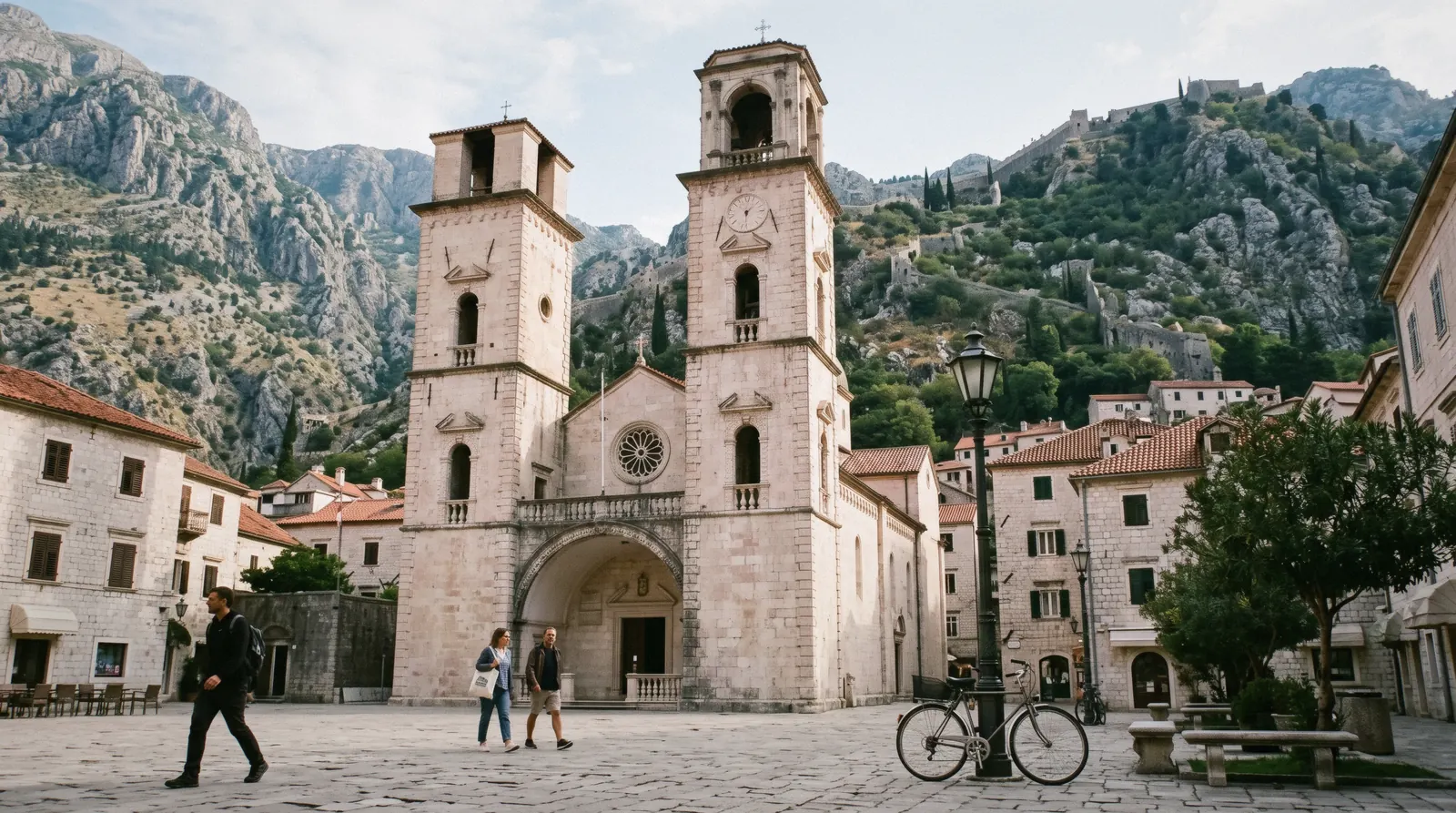
The Cathedral of St Tryphon: Kotor's 1166 Landmark
The Cathedral of Saint Tryphon has watched over Kotor since its consecration in 1166. Cathedral of saint tryphon The Cathedral of St Tryphon is the building Kotor was built around. It was consecrated in 1166, which makes it older than most of the houses around it, and it keeps the relics of the town's patron saint behind its altar. The two towers on the facade are famously unequal, a scar of the 1667 earthquake and the rebuilds that followed. Entry costs about €4 ($4.56), sources put the door price anywhere from €2.50 to €5, and the cathedral opens daily from roughly 09:00 to 19:00 in season. This page covers what is worth the ticket, what is free from the square outside, how long to allow, and how the cathedral fits into a day in Kotor. The official town tourism site is kotor.travel, which also runs the tourist info points by the Sea Gate and on Arms Square. The full guide lives on Kotor City Guide.
Quick answer The answer first, then the details that decide it
The Cathedral of St Tryphon stands on its own square in the middle of Kotor old town, a few steps south of Arms Square. It opens daily, roughly 09:00 to 19:00 in season, and admission is about €4 ($4.56) in cash, with published sources ranging from €2.50 to €5. Inside you get the Romanesque nave, fresco fragments, the treasury and the shrine of St Tryphon, the patron saint whose relics the church has kept since the twelfth century. From the square, the facade and towers are free to photograph at any hour. Twenty to forty minutes covers the interior comfortably. No booking is needed, no timed entry exists, and Sunday mass is held in the morning. If you want the story told properly, both the 70-minute old town walking tour and the 90-minute guided walk stop at the cathedral's square.
Key takeaways
- the 70-minute old town walking tour: $29.00 - the catches and the free-cancellation window on Kotor Old Town walking tour, 70 minutes.
- the 90-minute guided old town walk: $25.00 - the catches and the free-cancellation window on Kotor Old Town guided walking tour.
- The next stop after this page: Arms Square and the Clock Tower.
Key facts
Opening hours
| In season | 09:00–19:00 |
|---|
Closed Open daily
Admission
- Adult
- about €4 ($4.56), sources range €2.50-5
- Reduced
- not stated
- Free
- not stated
Planning it
- Time needed
- 20-40 minutes
- Book ahead
- Optional — walk-up usually fine
- Address
- Old town of Kotor, Montenegro
Tickets and Prices. Tour prices are as listed on the booking platforms in US dollars. the platforms bill in your own currency. The cathedral itself has no online ticket. Is the €4 inside worth it, or is the facade enough? The facade, the unequal towers and the square cost nothing and are visible any time. The ticket buys the Romanesque interior, the treasury and the saint's relics. The door price is small and adjusted occasionally, so treat €4 as the working figure and carry cash.
| Option | Price | What you get | Cancel | Book |
|---|---|---|---|---|
| Cathedral door ticket (official, pay at the door) | not stated | Official site | ||
| the 70-minute old town walking tour | Free to cancel up to 24 hours before | Check Availability | ||
| the 90-minute guided old town walk | Free to cancel up to 24 hours before | Check Availability |
Tour prices are as listed on the booking platforms in US dollars. the platforms bill in your own currency. The cathedral itself has no online ticket. Figures current in Q3 2026.
Guided Walks That Include the Cathedral's Square
Two licensed walks start at the Sea Gate and pass the cathedral square. Neither includes the door ticket, so carry about €4 ($4.56) in cash either way. The 70-minute old town walking tour is run by Montenegro Adventures DMC, a Kotor agency, and is rated 4.8 by 242 reviewers. The 90-minute guided walk from KBT - Active Tours is rated five stars by all 88 reviewers, costs less than the short tour, and moves slower.
Kotor in the twelfth century was.
Kotor in the twelfth century was a wealthy town on a deep, sheltered bay at the crossroads of Adriatic trade. The cathedral was consecrated in 1166, on a site where an earlier church to the same saint had stood. St Tryphon, a martyred saint from Kotor's trading world of the eastern Adriatic, had become the town's protector, and building a cathedral in his honour was both an act of devotion and a statement that Kotor mattered.
The building that resulted is Romanesque, in the style of the Adriatic's trading links rather than anything local, and it became the model for churches across the bay. Consecration in 1166 puts the cathedral among the oldest working churches on the eastern Adriatic coast. It has been the town's spiritual centre ever since, surviving earthquakes in 1563 and 1667 that wrecked much of the town around it, and it now anchors the UNESCO-listed old town, inscribed in 1979.
You can read the whole arc of the town's history on our old town page, and the cathedral's story is the spine of it.
St Tryphon is not a local.
St Tryphon is not a local martyr. His remains were brought to Kotor in the medieval period and the town adopted him as its patron, a patronage so complete that the saint's image still appears on Kotor's civic symbols. The cathedral keeps the relics behind the main altar, and the saint's feast day on 3 February is the town's biggest traditional date.
Kotor's carnival season traditionally opens around the feast, so if you visit in early February you will meet the cathedral as the townspeople do, at the centre of the year. The shrine and the reliquaries are part of what the door ticket covers, and they are the reason the building is a cathedral rather than simply an old church. For the wider bay, Our Lady of the Rocks in Perast holds a different kind of devotional art, baroque rather than Romanesque, and makes a natural pairing on a second day.
Look at the facade before you.
Look at the facade before you go in. The two towers are not twins. The 1667 earthquake, the same quake that wrecked Dubrovnik, badly damaged the cathedral, and the rebuilds that followed left the towers mismatched.
One was restored more fully than the other, and the asymmetry became one of Kotor's most recognisable sights. Earthquakes are the town's recurring trauma: there were quakes in 1563 and 1667, and the April 1979 earthquake damaged the town again, the same year UNESCO listed it. Each rebuild left traces, so the cathedral you enter is a layered building, Romanesque at heart with later repairs written across it.
The towers also serve as a navigation aid. Old town lanes are narrow and turn without warning, and the twin unequal towers rising above the rooflines are the easiest landmark to steer by. If you get lost, look up.
Our map of Kotor pins the cathedral at coordinates 42.42397, 18.76992, a two-minute walk from Arms Square.
Three things justify the ticket. First.
Three things justify the ticket. First, the Romanesque nave itself, wide and dim and cool, a rare surviving interior of its period on this coast. Second, the fresco remains and the layered stonework from the post-earthquake rebuilds, which reward a slow walk around the walls.
Third, the treasury, which holds the church's silverwork and reliquaries, including pieces tied to the cult of St Tryphon. Photography rules inside are not published in our sources, so assume restraint and follow the door staff. Sunday mass is held in the morning, and visits during services should respect the congregation.
The cathedral is the anchor of any things to do shortlist in town, and it pairs well with the Maritime Museum in the Grgurina palace, which charges the same €4 (children €1) and tells the seafaring half of the same story. On a rainy day the two museums plus the cathedral are the standard indoor plan, and our rainy day page builds an afternoon around exactly that.
The cathedral opens daily, roughly 09:00.
The cathedral opens daily, roughly 09:00 to 19:00 in season, with Sunday mass in the morning. No source publishes an out-of-season hour table, so expect shorter winter hours and treat the door board as the truth on the day. Admission is about €4 ($4.56), with sources ranging €2.50 to €5, in cash.
No booking, no timed entry, no line worth avoiding outside peak cruise mornings. English is widely spoken in the old town, and the tourist info points by the Sea Gate and on Arms Square can confirm same-day hours. Practical notes: the square in front gets its best light in the morning, the interior is cool even in August, and shoulders covered is the safe dress for any working church.
If a cruise day has filled the lanes, the cathedral is usually quieter than the walls gate, since the walls ticket at €15 ($17.12) draws the bigger queue.
The cathedral is a short visit.
The cathedral is a short visit by design. It sits mid-town, so it slots into any route. The table below is our working arithmetic from the sourced figures.
| Visit type | Time | What fits |
|---|---|---|
| Facade and square only | 5-10 minutes | Photographs of the unequal towers, free, any hour |
| Interior visit | 20-40 minutes | Nave, frescoes, treasury and relics on the door ticket |
| Cathedral plus old town walk | About half a day | The walled town takes a half-day on foot, and the cathedral is its centre |
| Cathedral, then the walls | Half a morning plus 45-60 minutes | The walls climb is about 1,350 steps to San Giovanni fortress, see our fortress guide |
| Sunday visit | Morning mass plus 20-40 minutes | Mass runs in the morning, visit around it |
Five sourced details that change how.
Five sourced details that change how you look at the building.
The cathedral sits mid-old-town, just south of Arms Square, inside the walls. From the Sea Gate you walk through Arms Square and follow the signs in under three minutes.
Near the Cathedral
Arms Square and the Clock Tower
Arms Square is the town's main square, reached from the Sea Gate, and the baroque Clock Tower of 1602 stands on it, built on the site of a medieval tower and leaning slightly toward the gate, with a medieval pillory in front. It is your navigation anchor for the whole old town and the tourist info point here can confirm cathedral hours on the day. The square is free, open at all hours, and takes five minutes to cross. See our old town guide for the full square-by-square route, and the 70-minute old town walking tour if you want it narrated.
The City Walls and San Giovanni Fortress
The walls run about 4.5 km above the town and the climb to San Giovanni fortress is about 1,350 stone steps rising roughly 280 m, 45-60 minutes up and about 30 down. The gate price is €15 ($17.12) in the main season with about €8 reported in winter, children under 12 free, and entrances are staffed 07:00-20:00 in the main season. No official page publishes the price, which is why our fortress page carries the gate-price honesty. Do the cathedral first, then climb late afternoon when the interior heat has passed. Our best views page ranks all the viewpoints including the free alternatives.
The Cats of Kotor
Cats are a civic symbol here: cat shops in the lanes, a cat museum in the old town, the Cats' Square by the Sea Gate, feeding stations, and the Kotor Kitties charity running spay-and-neuter. You will meet the town's cats within a minute of leaving the cathedral square, often asleep on the warm stones nearby. It costs nothing, kids love it, and the cats page explains why a port town adopted the animals so completely. Combine it with the cathedral on any old town loop, and see our Kotor with kids page for the family version of the day.
Frequently Asked Questions
How much does it cost to enter St Tryphon's Cathedral?
About €4 ($4.56) at the door, in cash. Published sources range from €2.50 to €5, and the door price is small and adjusted occasionally, so no exact figure is honest. It remains the cheapest ticketed sight in the old town, the same as the Maritime Museum and well under the €15 ($17.12) walls ticket.
What are the cathedral's opening hours?
Open daily, roughly 09:00 to 19:00 in season, with Sunday mass in the morning. No out-of-season hour table is published in our sources, so check the board at the door or ask at the tourist info points by the Sea Gate and on Arms Square.
Why are the two towers different?
The 1667 earthquake badly damaged the cathedral, and the towers were rebuilt unevenly, leaving the famous mismatch. The same quake wrecked Dubrovnik, and Kotor had already been shaken in 1563. The asymmetry is the most photographed detail of the facade.
What relics are in the cathedral?
The relics of St Tryphon, Kotor's patron saint, kept behind the main altar. The saint's remains were brought to Kotor in the medieval period and the town adopted him as its protector. His feast day on 3 February traditionally opens the carnival season, and the treasury holds the associated silverwork and reliquaries.
Is the cathedral ticket included in anything else?
No. No combined ticket covering the cathedral is published in our sources, and neither guided old town walk includes the door ticket, so carry about €4 ($4.56) in cash on top of any tour price. The hop-on bus ticket discounts the Maritime Museum and a bay boat ride, but not the cathedral.
How long should I plan for the cathedral?
Twenty to forty minutes inside, five to ten if you only want the facade and the square. It is a short stop that anchors a longer old town loop, and the walled town as a whole takes about half a day on foot.
Cathedral of St Tryphon on Film
Three videos that show the place before you go. They load from YouTube only when you press play.
What Are Some Notable Features Inside St. Tryphon Cathedral? - TalkingSoutheastEurope
A walk or ride through the subject of this page.
Video: Talking Southeast EuropeSt Tryphon Cathedral inside the walled City of Kotor
A walk or ride through the subject of this page.
Video: JedsumSacred treasury At Cathedral of Saint Tryphon In Kotor
A walk or ride through the subject of this page.
Video: Heliotropiummo1Videos load from YouTube only when you press play.
Prices, hours and terms are set by the venue or operator and confirmed at checkout.
We may earn a commission if you book through one of our links, at no extra cost to you. Full affiliate disclosure