 Kotor City Guide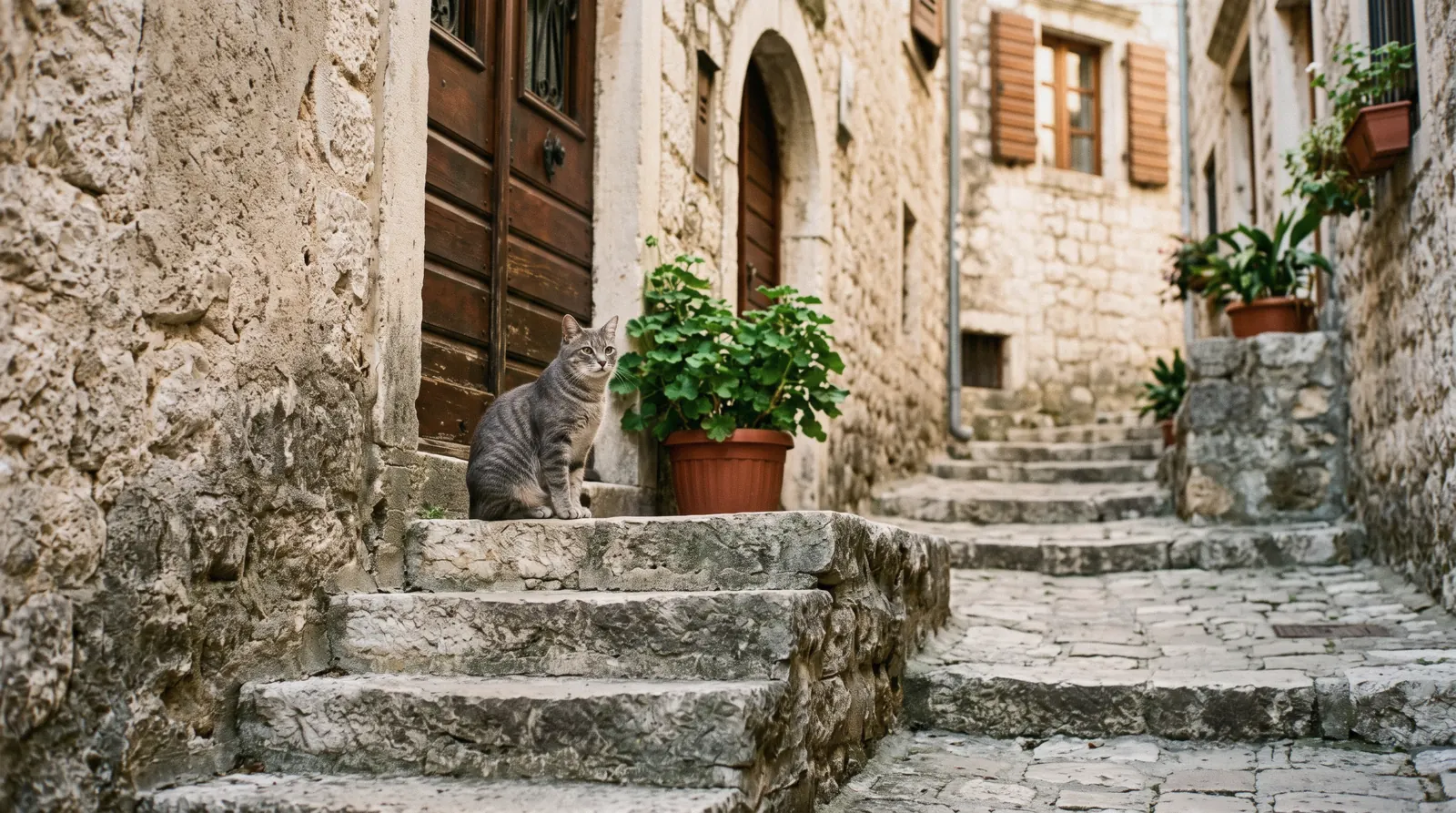
The Cats of Kotor: the Town's Favourite Residents
The cats of Kotor are not strays tolerated by a town. They are its symbol. Cat shops line the lanes, a small cat museum sits inside the walls, a square is formally named for them, feeding stations stand in the corners, and a charity called Kotor Kitties runs a spay-and-neuter programme across the population. No other sight in Kotor costs nothing, needs no booking and asks only that you be gentle. This page covers why the cats are here, where to find the Cats' Square, what the cat museum holds, and how to treat the animals the town considers its own. The full guide lives on Kotor City Guide.
Quick answer The answer first, then the details that decide it
Are the cats of Kotor worth planning around? Yes, and here is the short version. The cats are a civic symbol of Kotor, listed alongside its walls and its museum in the town's own description. You will meet them everywhere inside the walls, but the three fixed points are the Cats' Square (Trg od mačaka) right by the Sea Gate, the cat museum in the old town, and the feeding stations scattered through the lanes. Meeting them is free. The cat museum is small and takes well under an hour. If you want context as you walk, the Kotor Old Town guided walking tour covers the lanes where the cats sleep and costs US$25 on the platform. There is no published rulebook on feeding, so the honest guidance is to let the feeding stations and the charity's practice lead. Total time for a cat-themed wander: 30 minutes to an hour.
Key takeaways
- : $113.00 - the catches and the free-cancellation window on Montenegro highlights day trip with lake cruise.
- : $113.00 - the catches and the free-cancellation window on Montenegro highlights day trip with lake cruise.
- The next stop after this page: [](/cats-of-kotor/).
Key facts
Opening hours
| All year | Always available–not stated |
|---|
Closed None. The cats do not close.
Admission
- Adult
- Free to meet and stroke them. The town charges nothing.
- Reduced
- not stated
- Free
- Everything on this page except the cat museum's shop counter and any donation you choose to make
Planning it
- Time needed
- 20-40 minutes for the square and museum, longer if you stay to scratch ears
- Book ahead
- Optional — walk-up usually fine
- Address
- The Cats' Square (Trg od mačaka) by the Sea Gate, Kotor old town
Tickets and Prices. The cats are free and ungoverned by any ticket. Tour price is the platform's listed dollar price as of our check and the platform bills in your own currency. Come for the cats, or come for the town they own? The cats themselves cost nothing, which is rare in a town where the walls charge €15 ($17.12) and the cable car €25 ($28.53). The table below sets the free option against the guided walk that passes their territory. Tour prices are shown as listed on the booking platform, which bills in your own currency at checkout.
| Option | Price | What you get | Cancel | Book |
|---|---|---|---|---|
| Everyone. This is the one Kotor sight that costs exactly nothing and needs no ticket, no gate and no opening hour. | Everyone. This is the one Kotor sight that costs exactly nothing and needs no ticket, no gate and no opening hour. | Free to cancel up to 24 hours before | Check Availability | |
| Travellers who want the cats plus the history of the streets they sleep in, at a slow pace, for the lowest guided price in town. | Travellers who want the cats plus the history of the streets they sleep in, at a slow pace, for the lowest guided price in town. | Free to cancel up to 24 hours before | Check Availability |
The cats are free and ungoverned by any ticket. Tour price is the platform's listed dollar price as of our check and the platform bills in your own currency. Figures current in Q3 2026.
Tours That Pass the Cats
The cats belong to no tour, but one walk crosses their whole territory. The Kotor Old Town guided walking tour meets at the Sea Gate, a few paces from the Cats' Square, and spends an hour and a half in the lanes where the town's cats hold their favourite ledges. It is the slower and cheaper of the two old-town walks in Kotor, rated a flat five stars by 88 reviewers. If you would rather build a bigger day around the town itself, our Kotor tours and old town pages hold the rest.
Kotor's cats are documented as a.
Kotor's cats are documented as a symbol of the city, and the reason is older than the souvenir shops. This was a seaport for centuries, and ships have always carried cats to guard grain and rope from rats. Sailors coming ashore left animals behind, the port fed them, and a population grew that the town never drove out.
Over time the cats moved from working animals to residents with standing. Today the town's identity is described with its cats in the same breath as its walls and its museum: cat shops sell figurines, feeding stations and boxes stand in the lanes, and a square carries the cats' name. The 1979 earthquake, which damaged the town badly enough to place it on the UNESCO World Heritage list the same year, changed the stones but not the animals.
Walk the lanes at opening hour and you will understand the arrangement: the cats choose a warm slab, the town walks around them, and visitors take photographs. Nothing about it is managed by a ticket office. The cats simply predate the tourism and outlasted the empires, and Kotor decided that suited it fine.
For the wider setting they live in, see our old town guide and the bay of Kotor page.
Trg od mačaka, the Cats' Square.
Trg od mačaka, the Cats' Square, is the official name of the small square that greets you the moment you step through the Sea Gate, the old town's main western entrance built in 1555 in the Venetian era. That placement is the point. The Sea Gate opens onto the water side of the walls, the cruise pier sits about 100 metres away, and passengers walking 2-5 minutes to town cross this square first.
The cats knew a good spot when the foot traffic arrived. You will find them on windowsills, on the stone steps of the narrow lanes radiating from the square, and at the feeding stations the town maintains. The square is also where you will spot the first cat shops, because the figurines and cat-themed souvenirs sold here are described as the town's signature craft.
If you need tourist information, the info point sits by the Sea Gate itself, so you can collect a paper map and your first cat sighting in the same minute. Practical line: no ticket, no hours, always open. The square anchors the western edge of our Kotor map pins at latitude 42.42466, longitude 18.77119.
After the square, walk two minutes in to the Arms Square and the Clock Tower for the rest of the entrance sequence.
Inside the walls, the old town.
Inside the walls, the old town holds a museum dedicated entirely to cats. It is small, it is quirky, and it is exactly what the name promises: a collection gathered around the animal that Kotor adopted as its emblem. Pictures, objects and cat ephemera fill a couple of rooms, and the visit takes well under an hour for most people.
Our sources place the museum in the old town but publish neither an address to the door nor a ticket price, so treat both as confirm-on-arrival: the tourist info point by the Sea Gate can point you to it the same morning. What we can say is how it fits the day. The big ticketed museum of Kotor is the Maritime Museum of Montenegro in the Grgurina palace at €4 ($4.56) with children at €1 ($1.14), and the cathedral asks about €4 ($4.56) (sources range €2.50-5).
The cat museum sits at the lighter end of that scale, a 20-minute stop rather than an afternoon, and pairs naturally with a loop of the lanes where the live versions of its exhibits are sleeping on the walls outside. If rain closes your plans, the museum joins our rainy day in Kotor list alongside the Maritime Museum and a long taverna lunch.
The cats are not merely tolerated.
The cats are not merely tolerated, they are organised for. Kotor Kitties is the charity named in the town's own descriptions as running spay-and-neuter across the cat population. That is the machinery behind the healthy, calm animals you meet in the lanes: a town that fixes rather than culls, feeds rather than chases.
The charity's work is also why the cats you meet are approachable. Generations of animals raised around people who feed them at fixed stations have produced a population that will accept a scratch and ignore a camera. If you want to help, the practical route is the charity itself, not handouts on the street, and our feeding guidance below explains why.
Visitors who fall for a particular cat should know that the honest answer to taking one home involves import rules that this guide does not publish, and the charity is the right first call. What a visitor can do today is spend in the cat shops, where figurines and cat-themed souvenirs are the town's signature craft, and let that trade argue for the cats' continued upkeep. Kotor also asks little: the animals are part of why the old town rewards slow walking, and the free things to do in Kotor list counts the cats among the town's genuinely free sights alongside St Luke's church and the Sea Gate.
No official rulebook on feeding the.
No official rulebook on feeding the cats is published anywhere we checked, and that absence matters, because it means guidance comes from practice rather than statute. The town's own practice is the model. Feeding stations and boxes stand at fixed points in the lanes, which is how Kotor keeps the population fed without encouraging begging at restaurant tables.
Follow that lead: if a cat eats, let it eat at a station. Hand-feeding in the lanes trains the animals toward the tourist crowds, which is not the favour it feels like. Do not feed milk, a common error, and do not feed at all if you cannot judge what a cat should eat.
Stroking is welcome when the cat invites it. Most will approach, some will not, and none should be picked up, chased or cornered for a photograph, particularly in July and August when the lanes are busiest and two-ship days pack the old town. Wash your hands after handling, before eating, and before touching your own children's faces.
If you see an animal that looks unwell, report it to the tourist info point by the Sea Gate or to Kotor Kitties rather than trying to treat it yourself. The cats are fed, neutered and watched here. The kindest visitor is one who enjoys them and leaves the care to the system already in place.
English is widely spoken in the old town, so asking a shopkeeper where the nearest station stands is easy.
One: the square's name is official.
One: the square's name is official. Trg od mačaka appears in the town's formal descriptions, not just on souvenir signs, which puts Kotor in the rare company of towns that have written their cats into the map. Two: the cat shops are a craft story, not a joke.
Cat figurines are described as the town's signature craft, sold from small shops in the old town lanes alongside lavender and olive-wood pieces, and no official craft register exists, so no shop can be named here and none needs to be. Three: the cats survived what the town survived. Earthquakes in 1563 and 1667 nearly destroyed Kotor, the 1667 quake wrecked Dubrovnik too, and only St Luke's church from 1195 is said to have stood through them intact.
The cats stayed through all of it. Four: the cat museum and the live cats are a matched pair. Most visitors do one.
The museum's collection makes more sense after ten minutes watching the real animals hold their territory in the lanes. Five: the population is managed, not feral in the common sense. Kotor Kitties' spay-and-neuter programme is part of how the town is described, which means the calm cat asleep on a 400-year-old step is the product of a deliberate civic choice, not accident.
If you are building the day around animal-friendly walking, our Kotor with kids page rates the cats as an attraction of their own, and the 1-day Kotor itinerary slots the square into the entrance sequence.
The cat territory is small and entirely walkable. The pin marks the Cats' Square at the Sea Gate, the western entrance where cruise passengers arrive. Everything else on this page, the cat museum, the cat shops and the feeding stations, sits inside the walls within a few minutes' walk of that pin.
Nearby
Three sights sit within a short walk of the Cats' Square and pair well with a cat-themed hour.
Maritime Museum of Montenegro
The museum that explains why the cats are here. Kotor lived by the sea for centuries, and this museum in the Grgurina palace at Trg Bokeljske mornarice 391 tells that story, the same seafaring past that brought ship cats ashore. Admission is €4 ($4.56) with children at €1 ($1.14), and summer evening openings are reported in July and August, with the winter season from mid-October running short days. It is a ten-minute walk from the Cats' Square through the lanes, mostly on the flat, and makes the natural indoor half of a cat-and-history day. See our Maritime Museum page for the full picture.
St Tryphon's Cathedral
Consecrated in 1166, keeping the relics of Kotor's patron saint, badly damaged in the 1667 earthquake and famous for its two unequal towers after the rebuilds. Admission is about €4 ($4.56), with sources ranging €2.50-5 at the door, open daily roughly 09:00-19:00 in season. The cathedral stands two minutes from the Cats' Square on the route to Arms Square, so most cat hunters pass its door without planning to. The cats nap on the ledges of the churchyard walls in the morning sun. Our cathedral page covers the interior.
Kotor City Walls and San Giovanni Fortress
The walls run about 4.5 km directly above the town, and the climb is about 1,350 stone steps rising roughly 280 m, taking 45-60 minutes up and about 30 down. The ticket is €15 ($17.12) in the main season, with about €8 ($9.13) reported in winter from November to March, children under 12 free, entrances staffed 07:00-20:00 in the main season. No official page publishes the price, it is a gate figure. The cats patrol the lower walls and the first steps of the path, where the ticket office stands, though they sensibly decline the summit. If 1,350 steps sound like too much, the Kotor Old Town guided walking tour keeps you at lane level with twenty steps of climbing as the only effort. Full route on our fortress page.
FAQ
Why are there so many cats in Kotor?
Kotor was a seaport for centuries, and ships kept cats to protect cargo from rats. Sailors left animals behind, the port fed them, and the population stayed. Over time the town adopted them as a civic symbol. Cats now appear in Kotor's own description alongside its walls and museum: cat shops, a cat museum, the Cats' Square and feeding stations are all part of the record.
Is there a cat museum in Kotor?
Yes. The cat museum sits inside the old town and is dedicated to the cat as the town's emblem, with a small collection of cat-related objects and pictures. Our sources place it in the old town but publish no exact door address or ticket price, so confirm the details at the tourist info point by the Sea Gate. The visit takes well under an hour.
Where is the Cats' Square?
The Cats' Square, Trg od mačaka, sits immediately inside the Sea Gate, the old town's main western entrance built in 1555. The cruise pier is about 100 metres away and the walk from ship to square takes a few minutes. The square's position is latitude 42.42466, longitude 18.77119, and cat shops and feeding stations stand in the lanes around it.
Can you feed the cats in Kotor?
No official rulebook on feeding the cats is published, so guidance comes from the town's own practice. Feeding stations and boxes stand at fixed points in the lanes, and the better habit is to let the cats eat there rather than hand-feeding in the streets. Do not give milk. If you want to help, support the charity that runs the programme rather than feeding on your own.
Who takes care of Kotor's cats?
The town and a charity share the work. The town maintains the feeding stations and boxes named in its descriptions, and the charity Kotor Kitties organises spay-and-neuter across the cat population, which is why the animals are healthy and calm. If you see a cat that looks unwell, report it to the tourist info point by the Sea Gate or to Kotor Kitties.
How much time should I plan for the cats of Kotor?
Thirty minutes covers the Cats' Square and a first lap of the lanes. Add another twenty for the cat museum if it is open. Cat lovers with a full morning can fold the square, the museum and the free sights of the old town into a single loop, since the walls, the cathedral and the Maritime Museum all sit within a few minutes' walk of the Sea Gate pin.
The Cats of Kotor on Film
Three videos that show the place before you go. They load from YouTube only when you press play.
Kotor: A City of Cats in Montenegro!
A walk or ride through the subject of this page.
Video: Kitten LadyNew Cat Capital? 🐱🏰 Kotor - The City of Stray Cats, Montenegro | Cinematic Short Film 4K
A walk or ride through the subject of this page.
Video: Meow AroundKotor Montenegro: The Town Full of CATS
A walk or ride through the subject of this page.
Video: Field NotesVideos load from YouTube only when you press play.
Prices, hours and terms are set by the venue or operator and confirmed at checkout.
We may earn a commission if you book through one of our links, at no extra cost to you. Full affiliate disclosure